
Coaching The Switch Of Play: From The Board To The Pitch
Combine player positions, passing arrows and coaching notes to help players recognise when to switch play, then test the same decisions in an 8v6 practice.
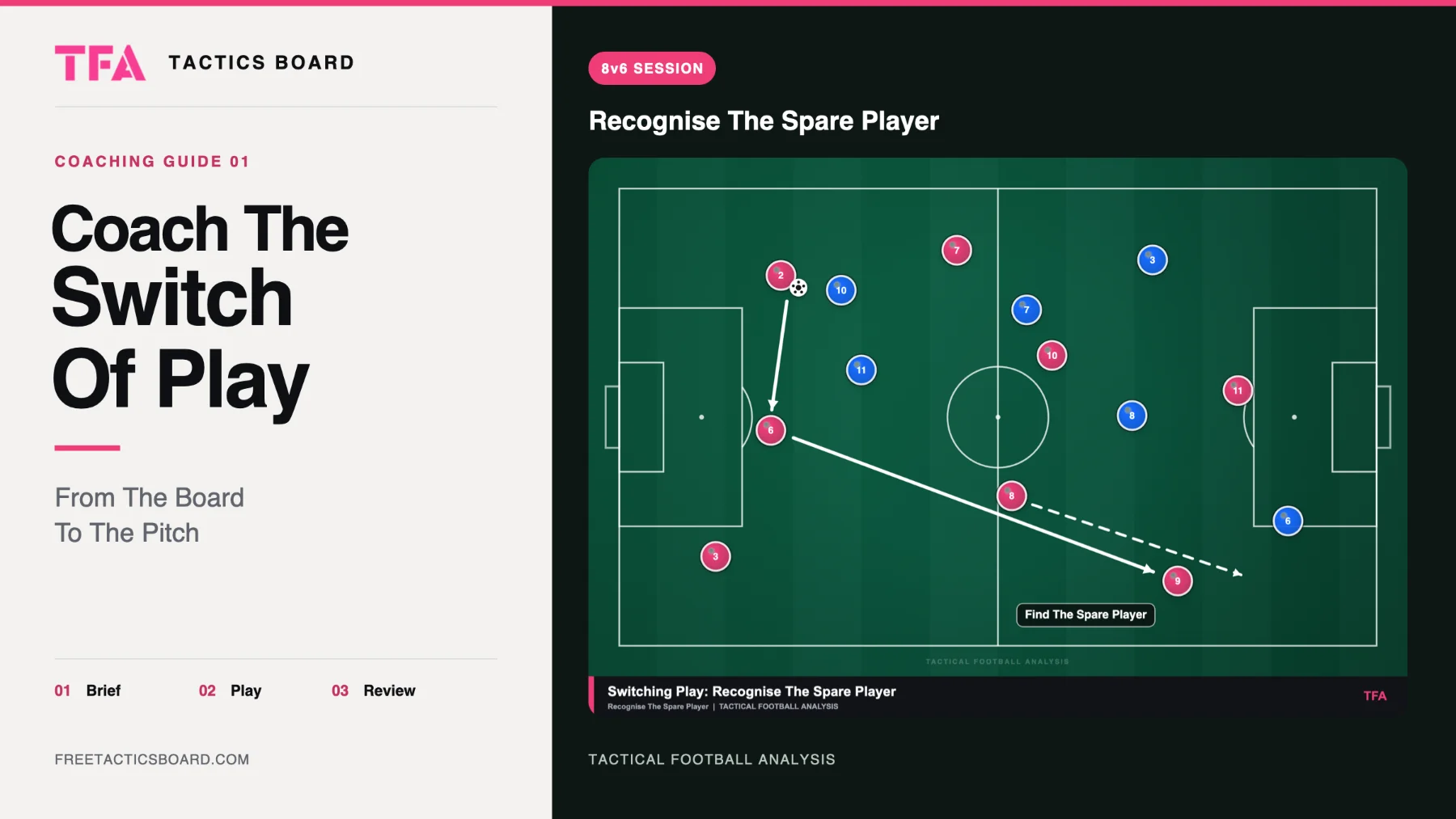
A team can move the ball from one side to the other without making the opposition particularly uncomfortable.
If the receiver has to stop, turn backwards and wait for support, the defending side often has enough time to recover its shape.
The useful coaching question is what needs to happen before the switch, and what the team should do once the ball arrives.
That gives us a clear purpose for the tactics board: put tactical theory into practice by identifying the pressure, showing the available support and connecting the next pass to an attacking advantage.
Start With The Decision Players Need To Recognise
In our example, the pink team are attacking from left to right, with the ball at number 2 and several blue players positioned towards that side.
Number 9 holds the opposite width, while number 6 offers a supporting angle behind the immediate pressure.
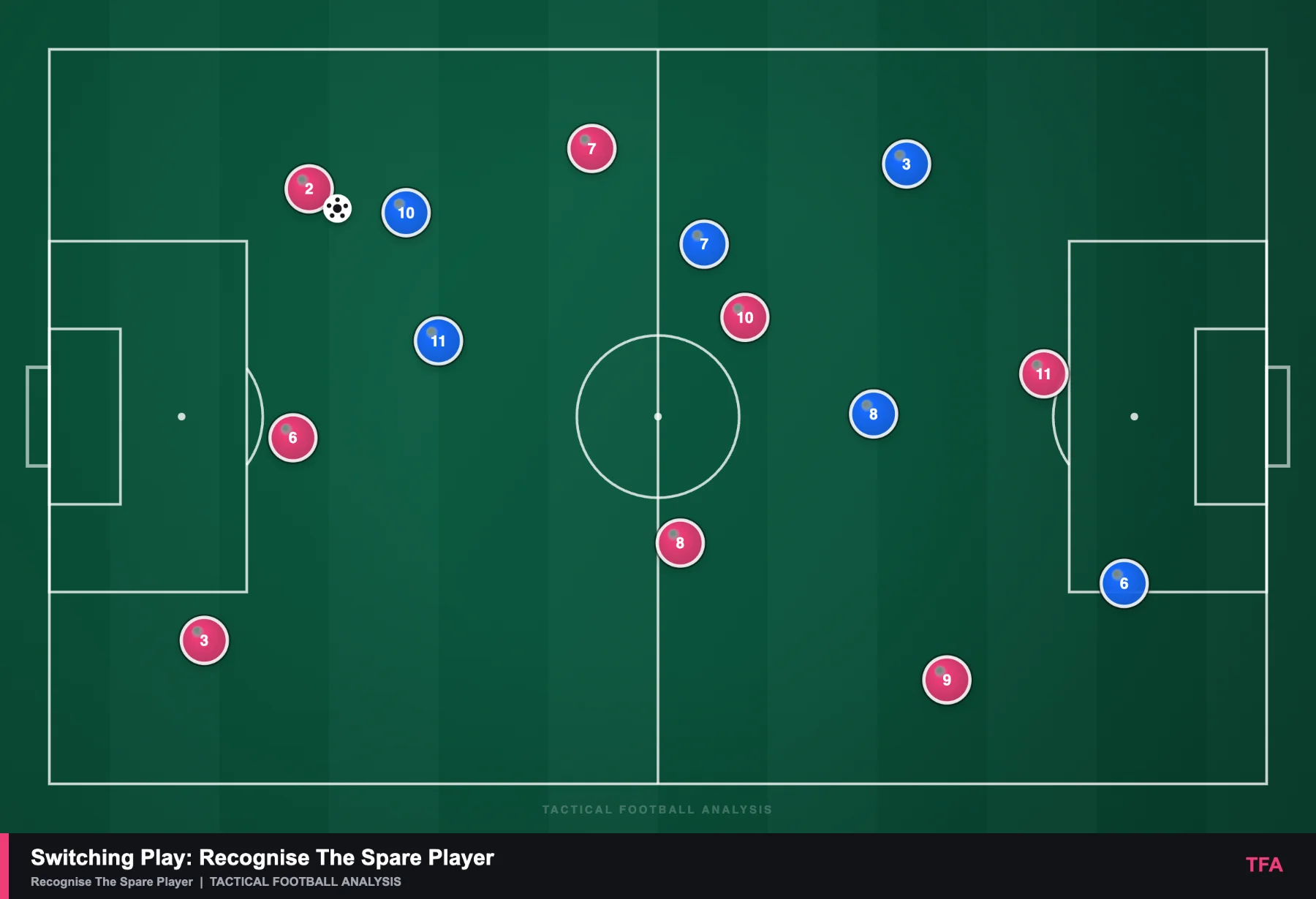
The starting picture shows pressure around 2 and space for 9 on the opposite side.
Before adding arrows, ask the players where they can receive with enough time to face forward.
Then move one blue player across towards number 9 and ask whether the same pass still makes sense.
The answer should depend on the opposition’s position, the passing lane and the receiver’s next action.
FIFA’s session with Ben Bartlett makes a similar point by working on different ways to switch, including direct passes and combinations through a supporting player.
I would keep that choice visible throughout the session, because a rehearsed sequence can quickly become something players follow without looking.
Give Each Board Feature A Coaching Job
Use the player numbers to identify responsibilities, then add the ball so everyone starts from the same picture.
Draw a pass from 2 back to 6 and another from 6 towards 9, with a run arrow showing 8 moving across to support.
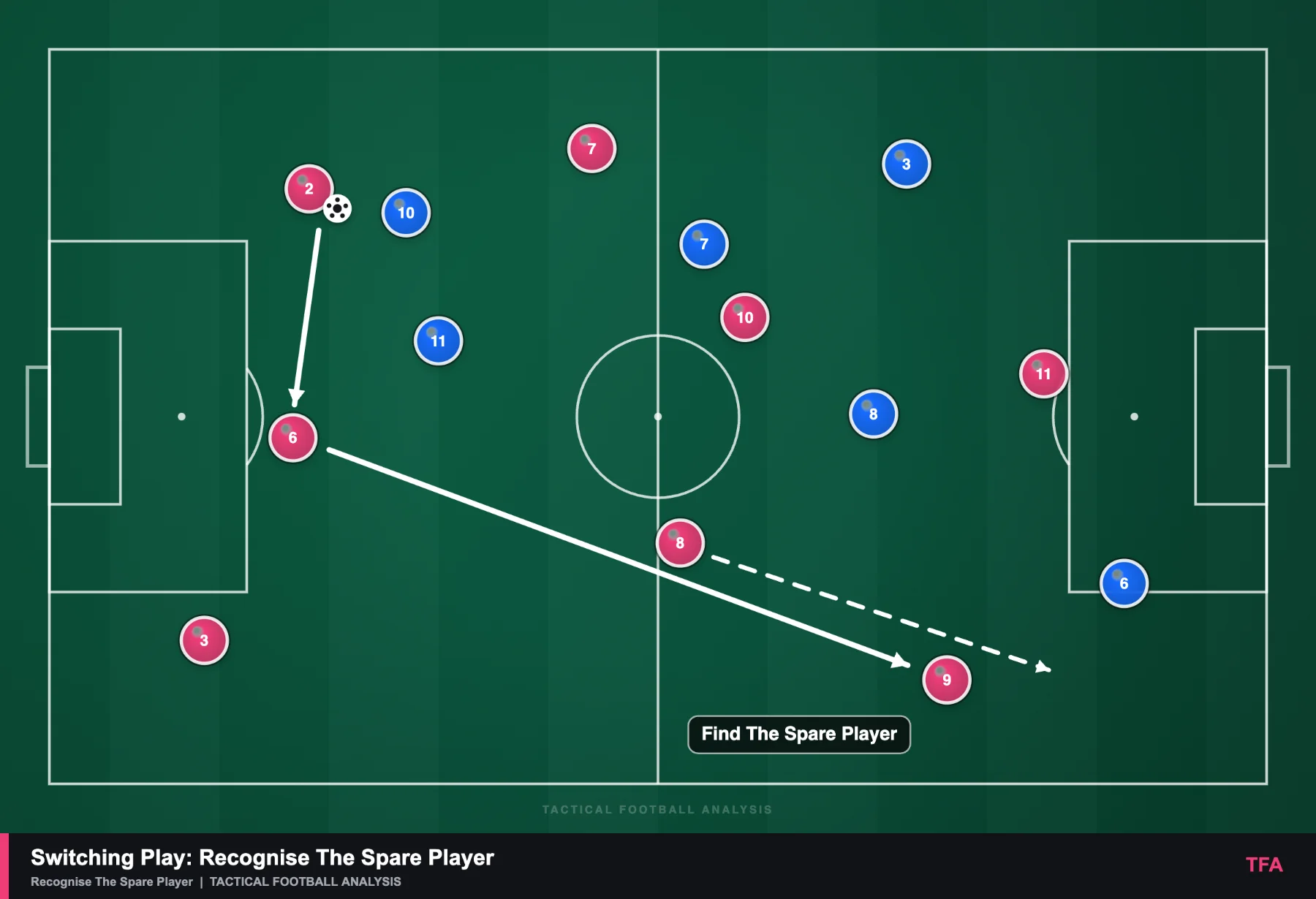
Solid arrows show passes through 6 to 9, while the dashed arrow shows 8 supporting.
The return pass gives 6 a chance to change the point of attack, provided the player has scanned and can receive with an open body shape.
The far side receiver should check the nearest defender before the ball arrives, then take the first touch towards useful space.
Number 8 needs to arrive on a different line, offering a combination without bringing another defender directly onto the receiver.
Keep 3 available behind the attack so the team still has support if the forward route closes.
A short label such as “Find The Spare Player” keeps the objective on the picture, while the coaching notes can hold the detail about scanning, pass weight and support timing.
For a wider look at the same idea, our TFA analysis of switching the point of attack examines how teams create wide overloads against an unbalanced defence.
Take The Same Problem Into An 8v6 Practice
The FIFA Talent Coach Programme provides a useful starting practice: eight against six in a 35 by 35 metre area, with two mini goals at each end, approximately 15 metres apart.
Both teams attack the goals at the opposite end, and the defending team can counter when they regain possession.
Keep spare balls around the area so the other team can restart quickly after a goal or when the team in possession puts the ball out.
Adapt the dimensions to the players and the passing distances they can manage while still being challenged.
For this version, begin with the eight providing width on both sides and a supporting player behind the ball.
Treat those as responsibilities that players exchange as the game moves, rather than fixed positions they must occupy.
The board pictures are schematics on the free full pitch view, not a scaled layout of this four goal practice.
Coach The Moment The Advantage Appears
Let the first block run long enough to see whether the players recognise the problem themselves.
Watch for the nearest defenders closing around the ball while the opposite receiver remains available.
If that receiver is being marked, encourage the team to keep looking for a forward option or use support to move the defence again.
When a switch is available, the quality of the pass matters: a slow ball can allow the defender to travel with it.
Ask the supporting player what they saw before receiving, and ask the wide player where their first touch could take them.
After a turnover, the closest players should respond to the ball while teammates protect routes towards their own goals.
Rotate players between the teams so the same group is not always working with the numerical advantage.
Progress The Practice And Review The Decision
A useful progression is to award an extra point when a switch leads to a goal, while keeping ordinary goals valid.
That gives players a reason to explore the far side without making them turn down an open route to goal.
Remove the bonus in the final block and look for the same decisions appearing without the scoring incentive.
Return to the board afterwards and recreate one moment that caused difficulty, including the defenders’ actual positions.
Ask which supporting angle or earlier scan could have changed the outcome before drawing the proposed solution.
The free board lets you combine positions, the ball, passes, runs, labels and notes, then export the picture as a PNG.
TFA members can organise the starting position, switch and next action into additional phases, or retain named boards for later work.
Keep the storage distinction clear: boards save in that browser, and member project export and import provide a way to move editable work between devices.
The review has done its job when players can explain why the switch was available and recognise the next opportunity on the pitch.