Training starts in twenty minutes. The bibs are out, three drills are set up in a line down the pitch, and the plan exists only as a rough order of activities in your head. Twenty players arrive, the first block runs long, and the session ends with a quick game nobody has time to coach.
That order of activities isn't a plan. It's a schedule, and nobody can check it, least of all you.
A session plan that specifies the decision, the trigger, the coaching cues and the evidence does two jobs at once. It lets another coach run the session without phoning you, and it lets you judge afterwards whether the players actually learned anything. Everything below is a way of making the plan checkable before the session and answerable after it.
Table of Contents
The Seven Parts Every Football Lesson Plan Needs
Lesson plan design works best when the plan is treated as a specification, not a timetable. A specification is short, but it's testable. Every line tells you what to set up, what to say and what to look for.
Classroom research has already made this shift. A 2023 design-based research study built a framework for evaluating lesson plans around seven criteria: two on whether learning intentions were clear and thorough, four on task design covering statistical literacy, investigation, real data and multiple representations, and one on how constructivist the lesson was. Teachers discussed, revised and taught their plans while feeding back on the framework (Vietnam Journal of Education study). The value is in turning broad ambition into observable features you can check off in advance.
A football session needs the same treatment. Seven lines do most of the work.
Plan part | Question it answers | Football example |
|---|---|---|
Objective | What decision should players make better? | Switch to the far winger when the near side is pressed |
Players and numbers | Who is involved and how many? | 6 attackers, 4 defenders and 2 neutral players |
Setup | What area, equipment and rules are needed? | Rectangular grid, neutrals on the sides, restart after each turnover |
Coaching cues | What will the coach say, and when? | Scan before you receive; weight to the far side |
Progression | How does the task get harder? | Remove a neutral after three successful switches in a set |
Adaptations | How does the task suit different abilities? | Extra neutral or extra touch for a less confident group |
Success criteria | What evidence shows the objective was met? | At least four of five attacks switch within three passes |
Two of those lines cause the most trouble in practice. Coaching cues get skipped because coaches plan to say everything, and then say too much. Success criteria get skipped because a session feels like it went well, which is not evidence.
Before opening a diagram, a drill list or a tactics board, write the seven lines in plain text. If any line needs more than a sentence, the session isn't defined yet.
Start From the Decision Players Must Make
The habit to break is starting with a favourite drill and working backwards to a reason for it. Start with the decision players have to recognise in a match: when to switch the ball, when to press the next pass, when to drop into the pocket behind a screening midfielder.
A decision is visible on the pitch if you describe it properly. It has a trigger (the near-side press closes the passing lane), a target (the far winger, or the space in front of them) and a cost of getting it wrong (the ball goes backwards under pressure and the team resets).
Here's an illustration of the shape of that choice.
State the decision as one sentence a player could repeat back to you: when the near-side press closes, look for the far winger before the pass is forced. That sentence is the objective, and it's also the thing you'll coach, freeze and review.
Vague aims fail. "Play better in possession" produces plenty of activity and no measurable change, because nobody in the group knows what to do differently. A formation tells players where to stand; a tactical framework tells them what to look for, and the distinction is set out clearly in this explanation of how football tactics fit together.
Connect the decision to the phase of play
Every objective belongs to a phase: build-up, final-third attack, defensive transition, or a set-piece restart. Naming the phase stops the session drifting across three unrelated problems in ninety minutes.
Say a coach notices the team stops after the first pass whenever they meet a mid block. The objective becomes receive facing forward on the far side, and the phase is build-up. Nothing else needs to enter the session.
The test: if you can't state the decision and the evidence of success in one sentence each, the plan isn't ready to be drawn.
Build the Session as Game, Practice and Game
The structure that keeps a session honest is the one in the FA's guide to running a team: a whole-group game, a smaller practice, then a second whole-group game. The opening game reveals the problem, the practice isolates it, and the final game tests whether players can apply it. The FA's practice examples include 2v2, 3v2 and 3v3, which are small enough for high repetition and specific enough to have one clear trigger.
Run it as a routine.
Open with a game of 8 to 10 minutes. Let it play and resist the urge to stop it constantly. The problem has to appear in its natural habitat before it's worth isolating.
Name the moment in one sentence. Not a lecture, a label: "that's the one, the switch went backwards because nobody scanned."
Build a smaller practice around that moment. Use 2v2, 3v2 or 3v3 with a trigger that forces the decision you named.
Coach it with two or three cues and short sets. Long queues kill repetition and let the group cool down mentally.
Finish in a whole-group game and ask players when they used it. Their answer is the transfer check.
The reason for the sequence is simple: a game diagnoses, a practice isolates, a second game verifies. Ending on the practice is the most common slip, and it leaves the learning untested under real opposition.
Put retrieval into the plan, not just the warm-up
Teaching guidance from MIT sets out evidence that actively retrieving recently learned information improves long-term retention and transfer compared with passive restudy, and that spacing repeated exposure over time beats cramming. Applied to coaching, that means a 60-second recall at the start of the practice block (players redraw or describe the decision from last week), prediction questions frozen into the practice, and the same principle revisited next session rather than drilled to death in one evening.
A hypothetical 60-minute session using this shape: 10 minutes warm-up with recall, 15 minutes opening game, 20 minutes practice, 15 minutes final game with two short freezes.
Progress Difficulty From Drill to Game Realism
Sessions fail at the seams. A group looks sharp in a technical drill, then falls apart in an open game, and the plan never explains the gap. The FIFA Training Centre's principles of effective session design describe three phases that close it.
Phase | Numbers and area | Repetition and decisions |
|---|---|---|
Skill development | Low player numbers, tighter area | High repetition, fewer decisions |
Progression | More players, more space | Fewer repetitions, more decisions |
Game phase | Most or all players, game-realistic setting | Fewest repetitions, decisions tied to genuine match problems |
Read the rows as a ramp, not a menu. Realism and uncertainty increase together, and the plan should show the checkpoint that allows the group to climb.
Use a success criterion as the gate
Before moving up a row, the group completes the previous decision against your written criterion. For a switch-of-play objective, that might be three clean switches in a row with the first receiver scanning before the ball arrives. If they can't hit it, the next phase will expose them rather than stretch them.
The same ramp works inside one session or across three weeks. A plan that runs skill development on Monday, progression on Wednesday and the game phase on Friday is still following the model.
Watch for the jump
The warning sign is specific: players execute the technical action correctly but can't choose when to use it in a game. That's not a motivation problem. It means the progression skipped a layer, and the fix is a middle step with more players and more space but a reduced decision load. Small-sided formats are the usual place to build that step, and there's a practical starting point in this guide to small-sided games in football training.
Designing backwards from the whole performance is the principle behind Four-Component Instructional Design. A quasi-experimental study of 34 education undergraduates tested lesson designs that exposed learners to the whole task early, then simplified conditions before restoring realistic constraints, and reported gains in cognitive strategies and structural models during the early sessions when that simplifying sequence was maintained (Educational Technology Research and Development study). On the grass, the equivalent is showing the whole tactical problem, isolating one constraint in a small grid, then recombining it in a representative game.
Adapt the Pressure Without Changing the Objective
Ability differences are usually handled with extra worksheets or a second session plan. Neither is needed. The FA's formats guidance recommends starting unopposed where necessary and then adding pressure progressively: one defender presses, then two defenders press, before full opposition. It also notes that some players may start at a higher challenge level than others.
That gives you a ladder to write into the plan.
Less confident group: start unopposed or with one passive defender, allow an extra touch, add a third neutral player.
Middle group: one live presser, two touches, neutral players locked to the flanks.
Confident group: a second presser, a touch limit, or a time limit before the switch must be played.
Change the pressure and the support. Never change the decision.
The success criterion stays identical across groups so results are comparable. Two groups can both target four of five switches within three passes; the first earns it with a third neutral, the second against a second presser. Same objective, same evidence, different resistance.
One plan, one line per group
Write adaptations as a single line per group in the plan, not as a parallel document. Next coach, or next week's version of you, can then see exactly what changed and why. It also keeps differentiation where it belongs, in the task design, rather than in extra printing.
Mixed-readiness squads are the reason this matters. Groups of 12 to 16 with three distinct levels are normal in amateur football, and a plan that only describes the middle level will lose both ends of it inside fifteen minutes.
A 6v4 Switch-of-Play Session
Here's a fully worked example, hypothetical and deliberately narrow.
Objective: when the ball is central, the first receiver scans and switches to the far side within three passes. Players: 6 attackers against 4 defenders, plus 2 neutral players who play for the attacking team, 12 in total. Setup: a rectangular grid with the neutrals on the sides, a restart after each turnover, and group rotation after each set.
A visual of the shape helps before you build the practice.
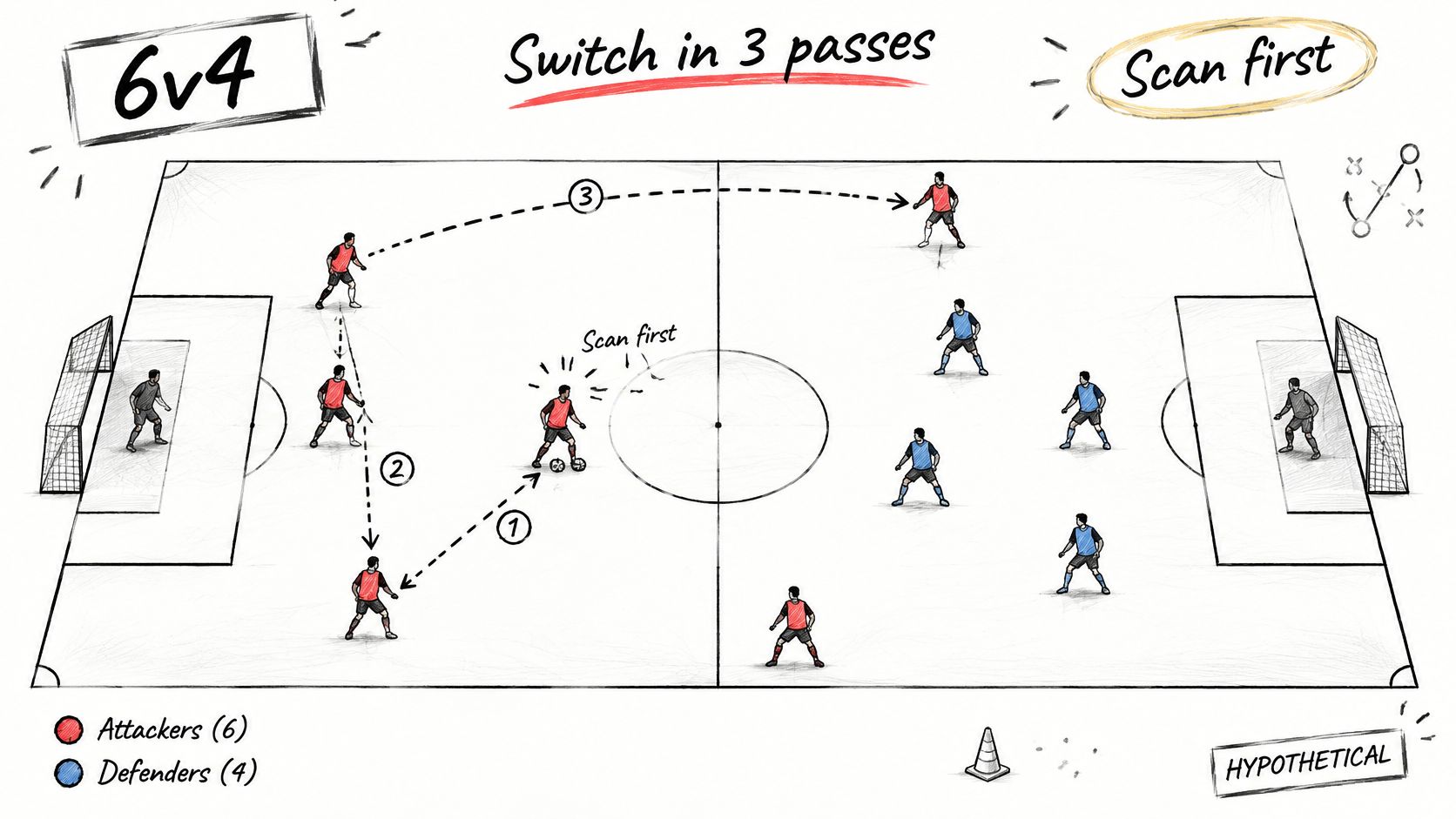
Coaching cues: scan before you receive, weight to the far side, attack the space you've created. Progression: once the group completes three switches in a set, remove one neutral, then restrict to two touches. Adaptations: a third neutral or an extra touch for a less confident group; a fourth defender for a stronger one. Success criteria: at least four of five attacks switch within three passes.
Draw it once, properly
The 6v4 shape and its arrows can be built on the TFA Tactics Board (Free Tactics Board) by Tactical Football Analysis, which runs in the browser and follows four steps: choose the starting shape, map the football action, add the coaching detail, then export and communicate.
Formation setup and manual player positioning, the ball, pass and run arrows, labels, player numbers, team colours, coaching notes and PNG export are free, with no software download. Advanced movement and drawing, zones and spotlights, focused pitch views, additional phases, the board library and member sharing and presentation controls are paid TFA member tools. Check the live site for current features and access before relying on any of it.
Plan rule: a diagram earns its place only when every arrow maps to a written cue and a success criterion.
Before the session, check each player number, position and arrow against the written plan. A board with mismatched numbers teaches the wrong picture.
Fix the Problems That Stall a Session
The clearest symptom of an unclear objective is players switching the ball without looking first. That happens when the plan names a technique but no trigger and no target zone, so players copy the movement and skip the perception that makes it work.
Other failures show up in patterns.
Symptom | Likely cause | Fix |
|---|---|---|
Players switch without looking first | Objective is too general | Name one trigger and one target zone |
Long rests between attempts | Sets too large or no rotation | Reduce set size and rotate after each set |
Session becomes a scrimmage early | Progression jumped to the game phase | Return to a 2v2 or 3v2 layer |
Strong players dominate | No ability adaptation planned | Add a touch limit or extra support for the weaker group |
Diagram looks right, practice fails | Plan shows positions, not decisions | Add coaching cues and success criteria to each phase |
Two of those fixes take effect in the next session: naming a trigger and cutting set size. The others need a week or more of repetition, because a group has to unlearn the habit of skipping the scan.
Judge the plan, not the players
After the session, compare what happened against the success criteria you wrote in advance. If you're guessing, or if the criterion was never written, the fault sits in the plan. Keep each change to one adjustment and one measurement so you can tell what worked.
A coach who changes the area, the cues and the numbers at the same time learns nothing from the next session.
Review the Plan Before Your Next Session
Five questions catch most of the faults, and they take four minutes.
Is the objective one decision? If it names two, split the session.
Can another coach find the trigger and the target zone? Hand the plan over and ask them.
Do the player numbers match the diagram? Count them, don't glance.
Does each progression have a success criterion? No criterion, no step.
Is there an adaptation for the weakest and the strongest group? Both ends, not just the middle.
If a template or an AI tool drafted part of the plan, run it through the same five questions before it reaches players. Lesson plan quality responds to structured review: a U.S. Institute of Education Sciences evidence review reports a randomised study in which teachers who received intensive professional development on inquiry-based lesson planning, followed by a further year of online tools and courses, produced significantly improved lesson plans. A meta-analysis of 28 studies with 49 effect sizes found a medium overall effect on teacher self-efficacy, with feedback on lesson plans associated with a larger effect.
Check it with the board open
Draw the starting shape, place players manually, confirm numbers and positions, then add arrows and cues. A diagram shows a plan, not evidence, so verify what each arrow means before sharing it with players or staff. Board storage is local to the browser, so export a PNG to keep a copy.
The free board at TFA Tactics Board opens without a download, which is enough to check a shape and its arrows. Further session-design guidance sits in the Coaching Blog, which offers practical coaching ideas, tactical frameworks and session-design guidance.
Write the seven parts for your next session, then run them through these five questions.
TFA Tactics Board puts the checkable plan on one screen: pick a formation or place players manually, add the ball, pass and run arrows, labels, shirt numbers, team colours and coaching notes, then export a PNG for the staff group. It's browser-based with no download, so the seven lines and the diagram can be reviewed together before training starts. Visit TFA Tactics Board to build your next session.