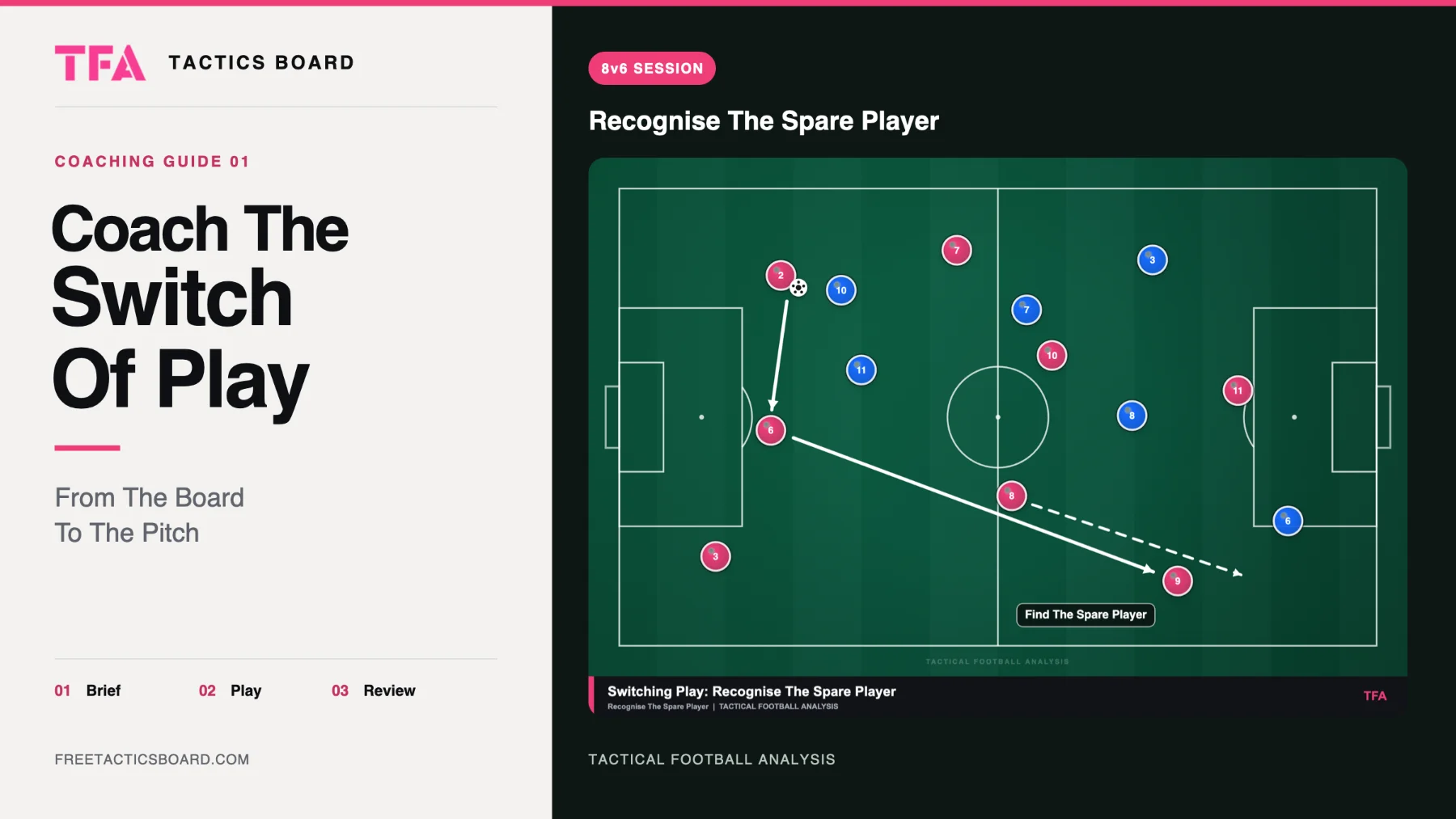
Small Sided Games Football: 8 Games with Coaching Points

The cones are down, the group is mixed, and the first bout starts in a few minutes. Eight options for small sided games football are on the sheet, and none of them coach themselves. A small-sided game works when you know which decision players must recognise before the first pass. Name that decision, then choose the game.
The order is deliberate. Rondo feeds four-goal, box feeds pressing trigger, and the regained ball then runs through 3v2 overload, positional zone, wing play and channel duel. Possession comes first, so players practise scanning, body shape and the weight of the pass. Pressing follows, so they learn when to step and when to hold a lane. Read every setup the same way: area, numbers, scoring rule, and the first change you will make if the picture is wrong.
Age does not need a new game. It needs a different progression. A bigger grid and a third touch keep younger players on the ball; a smaller grid and a two-touch limit ask more of an experienced group. A 2021 umbrella review of small-sided games screened 176 studies and analysed 12 systematic reviews, treating these practices as games in which the coach changes player numbers, pitch size, rules, scoring or equipment. It reports that larger pitches raise internal load, external load and the space between teammates, while smaller pitches raise how often players act on the ball. The label 4v4 does not tell you the demand. The space and the rule do.
Table of Contents
1. Rondo (Possession in a Grid)
A rondo is a marked square or circle in which the outside players keep the ball and the inside players try to win it. The decision is simple and ruthless. When do you play, how heavy is the pass, and where does the receiver's first touch go? Typical working formats are 4v1, 4v2, and 5v2. Attackers score for consecutive passes. Defenders swap in when they win it.
For a 4v2, mark a square from 10m x 10m to 15m x 15m and put attackers on the corners. You need 4 to 6 attackers and 1 or 2 defenders. Reducing player numbers and the area raises total ball contacts per player, so technical actions come more often, as a systematic review of small-sided design reports. That repetition is the point. It is not a full match, and it should not pretend to be one.
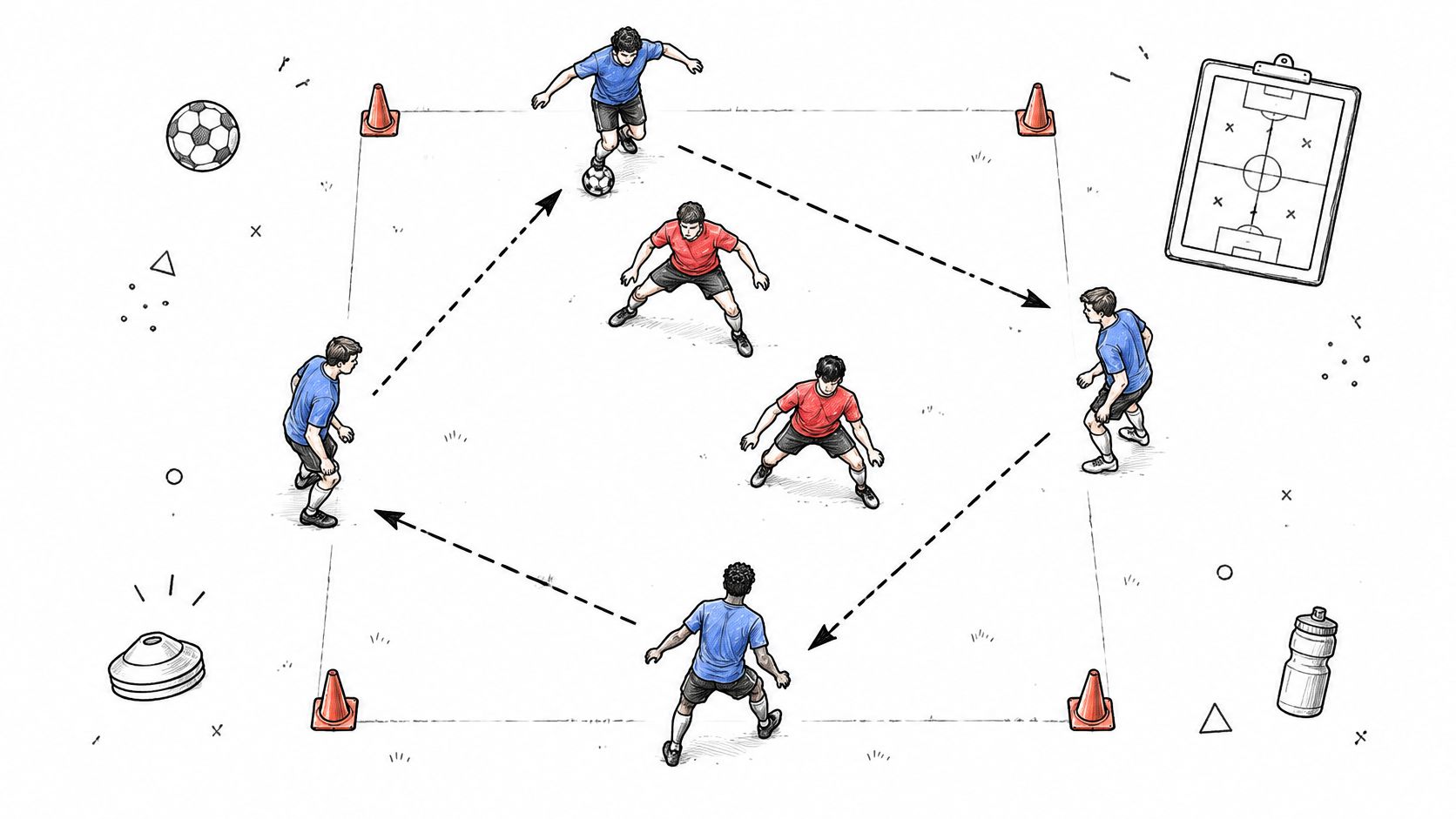
Look for the body opening before the ball arrives, a scan on the way in, a pass into space the receiver can use, and a move after the pass that offers a new angle. Build it in steps.
Free play: one point for every 5 passes.
Two touches: same scoring rule.
Movement condition: the pass must find a player who has moved.
Tighter picture: 5v2, or 4v2 in a smaller grid.
Forward rule: a forward pass, or a transition goal, before the ball is “kept”.
Younger groups get a larger grid and three touches. Advanced groups stay on two touches with a fixed pressing rule. A hypothetical example is a 4v2 in a 12m x 12m grid, two touches, one point per five passes, used as the warm-up for a possession block. More contacts do not mean better decisions, so score the pass and watch the body. Further session ideas sit in these small-sided games articles.
Practical rule: Rotate the defenders every bout so every player feels pressure, not only the two who enjoy tackling.
2. Four-Goal Game (Possession with Transition)
Two teams, a rectangle, a goal on each end, and a second pair on the sides. Players score by passing through a goal or by dribbling through it. Pick one method and keep it all session. The decision players must recognise is whether to keep the ball, switch it, or attack the goal that is open.
Set 30m x 20m for 6v6 or 8v8. The game still works from 4 to 16 players if you split evenly. Width is the teacher. If the opposition pinches one end, the free goal is elsewhere, and the first look after a regain should find it.
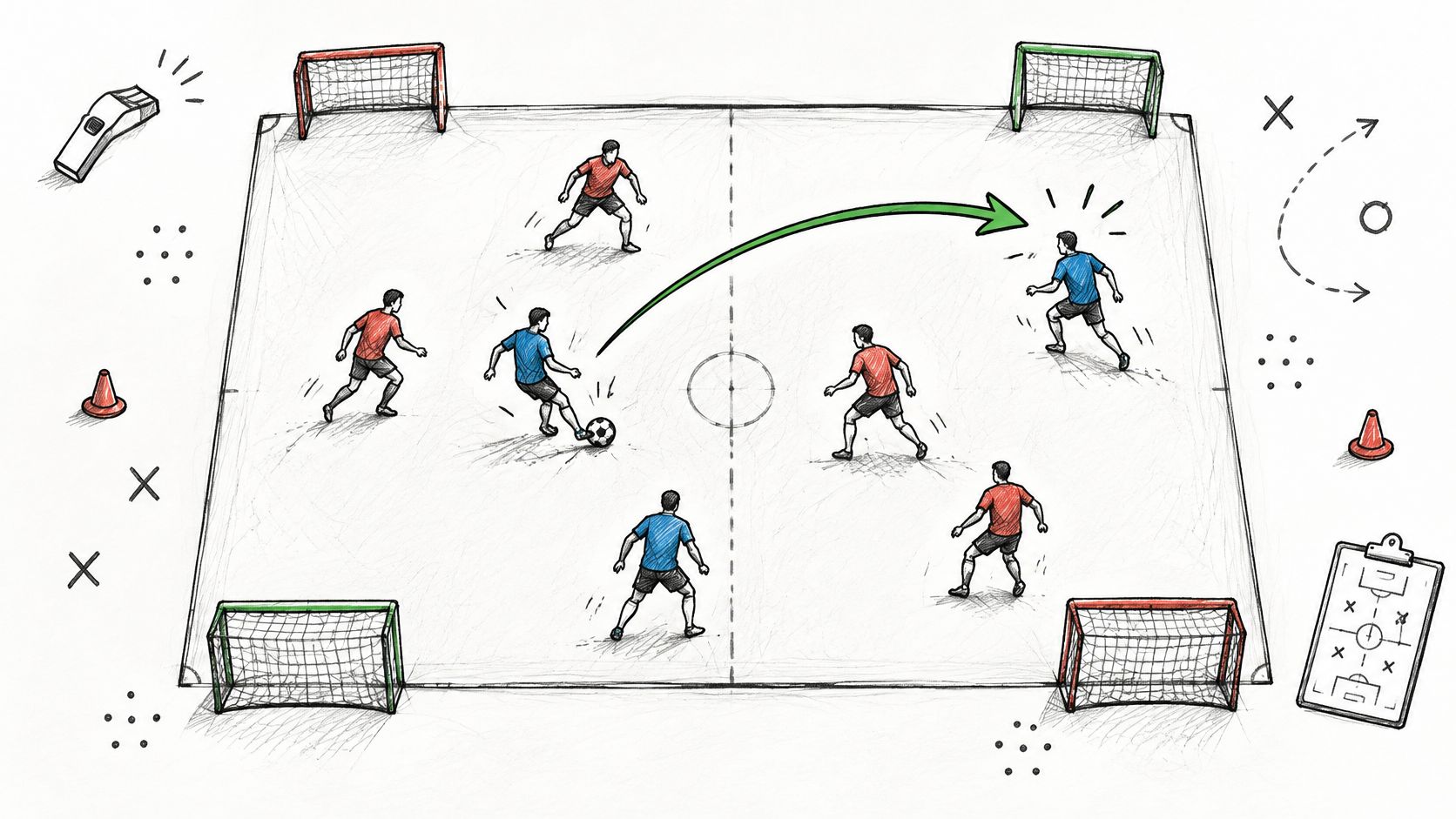
A larger pitch is not a cosmetic change. Compared with smaller pitches, larger ones produced higher heart rate, perceived exertion, total distance, and high-speed running in a 2022 meta-analysis of pitch size. Use the 30m x 20m only when you want that running and that spread. Shrink it when you want the switch to happen under tighter pressure.
Stop the game once, at the moment a switch creates the goal, then restart. Cones on the posts narrow or widen the target without a new rule.
Free play, two goals a side.
Two-touch limit.
An extra point if the goal follows a switch.
A neutral in the middle, always with the team in possession.
Neutral removed, and a pass into the opposite half before a score.
Younger players need wider goals and the right to dribble through. Experienced players get narrower goals and a time limit on each attack. A hypothetical example is 8v8 in 30m x 20m, with the extra point only after a switch, placed in the middle of a possession-to-transition block. Defend by keeping the body between the ball and the nearest opponent. Attack by hunting the open goal, not the nearest one.
3. Box Game (Pressing and Winning Possession)
A divided grid asks a harder question than a plain press: do I step out of my zone to chase, or hold the shape and pass the carrier on? Each team defends its own boxes and attacks through them. A point comes from winning the ball, then finding a target player or a target zone. The decision players must recognise is when to press, when to hold, and which passing lane to cut.
Use 8 to 10 players, usually 4v4 or 5v5. Mark a 20m x 20m grid in three zones, or a 25m x 25m grid as four boxes. The nearest player presses the carrier. The second player covers the easy pass rather than doubling up on the ball. When play sits in the middle zone, the team stays narrow and shows the carrier toward the edge.
Compactness is your main read here. Heart rate can look steady while the actions you care about swing: a review of 24 studies, from 1v1 through 7v7, found internal load and low-speed running relatively consistent inside sessions while technical execution and high-speed running varied much more, as that review of small-sided soccer games records. Count regains and entries into the target zone. Watch whether the covering player stayed connected after the press.
Progress from free play, to a pass into a named zone, to a support player arriving within two seconds of the press. Then add a neutral who must be used to score. The last step is 6v6 with an extra defender, so the covering shape has to be organised rather than lucky. Newer groups get a larger grid and a longer wait before pressure. Advanced groups shrink time and space, and a turnover must become an attack within three passes.
A hypothetical example is 5v5 in 20m x 20m, three zones, one point for the regain and a second for the pass into the target zone, sitting between a rondo and a pressing-cue game in the session block. Keep cone lines visible. On a narrow or portrait setup, check the grid fits the grass before you start, or the zones become a guess.
4. Pressing Trigger Game (4v4 with Pressure Cues)
The press is illegal until a cue appears. A pass reaches a player facing the wrong way, a touch runs heavy, or a receiver takes the ball with their back to the presser. The game hangs on one decision: is this moment worth pressing? Chasing every pass fails the rep even when the ball comes back. Holding position when no cue has fired is the skill being trained.
Mark 25m x 20m, with two goals at each end and either a neutral player or a free zone between the lines. Eight to ten players covers 4v4 or 5v5. Until the trigger fires, the defending team holds its shape and protects the forward lane. Once the ball is won, the nearest goal is the first look.
Name each cue so the call is a single word.
Back foot: receiver is facing away from the presser.
Heavy touch: the ball runs away from the body.
Wrong side: the body shape leaves the forward lane open.
The coaching point is collective recognition. When the cue fires, the whole line should step together. A lone presser with nobody reacting behind them means one player read the cue and the rest missed it. Watch for that gap and freeze the play the moment it appears, so the group sees the cue and the response side by side.
Start with one cue. A hypothetical example is 4v4 in 25m x 20m, press allowed only when the receiver has their back to the presser. Stop once at the moment the trigger fires, show the read, then play again. Add a second cue only when the first is clean.
Build the condition in stages. Open with free play and a point for any regain. Restrict the press to one named cue, then hand the call to the players: the press goes when someone shouts the cue word. The last step is a conditioned cue, such as pressing only when the ball travels backwards, so the read has to happen inside the play. Younger players need a visible cue, such as a bib colour. Advanced players get quieter cues and must talk before they step. If the cue fires and nobody moves, slow the game down and repeat the read. The pitch size and numbers are already doing their job.
5. 3v2 Overload to Goal (Attacking Transition)
Three attackers against two defenders is a counting problem with a finish. Players must recognise the overload and use it before it disappears. The decisions are when to pass, when to carry, and when the shot is on. Wasting the extra player is the common miss.
Use a 30m x 20m area, two goals, and a line of cones as a start mark. Five outfield players is the core, three against two, plus a goalkeeper if you have one. Attack with a purpose. Width stretches the pair. The pass should hit the space behind a defender, and the shot comes when the angle is real, not when the first player is bored of passing.
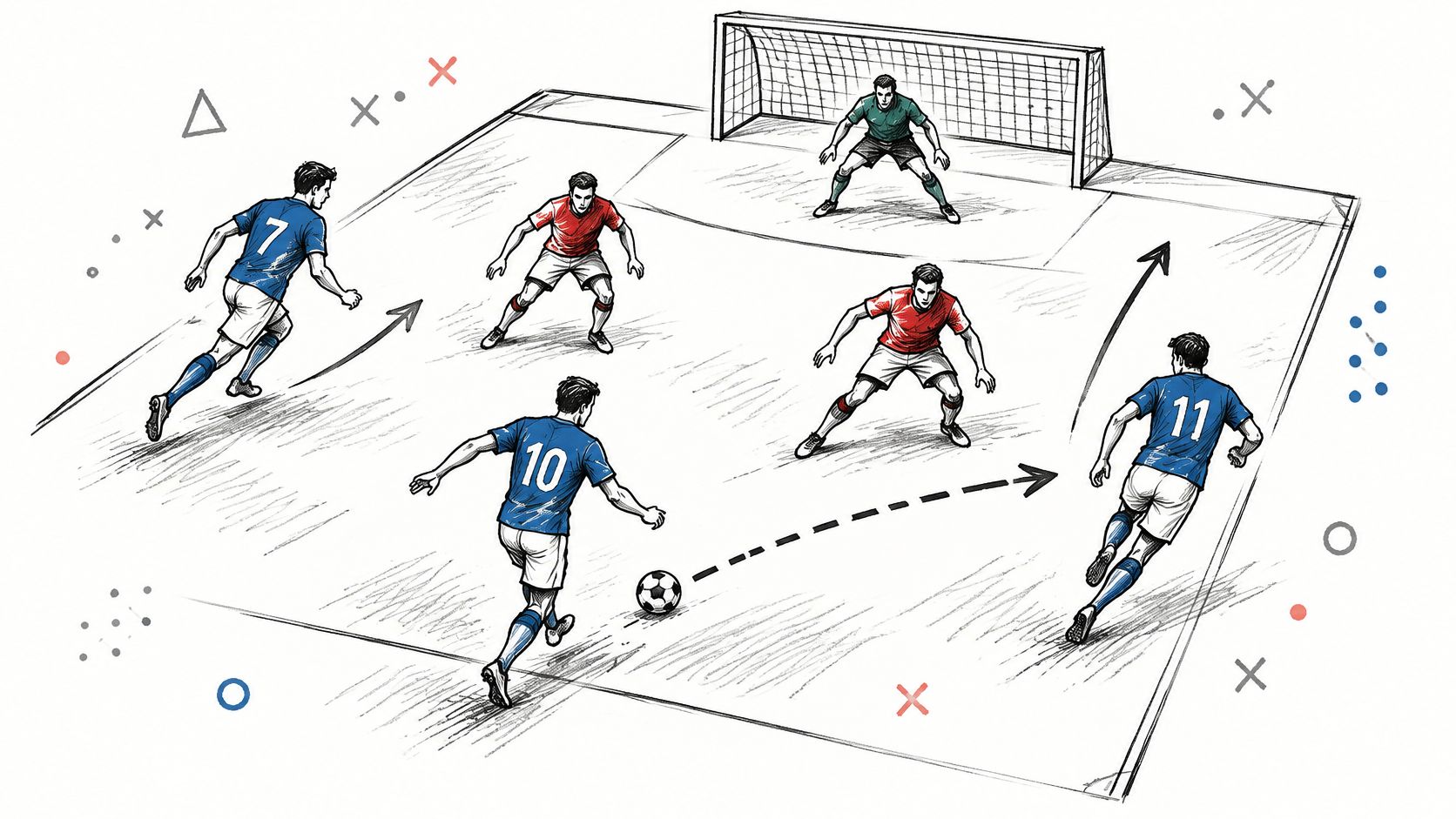
A clean progression keeps the overload honest.
3v2 to goal, no recovery runner.
A recovery defender starts behind the attack.
A pass is required before the shot.
A second wave of attackers joins.
Defenders who win it may counter.
Set the shooting rule before the first rep, after one pass or after two, and do not change it mid-bout. Coach the first pass and the movement of the other two, not only the player on the ball. Younger players may dribble, and the goal should sit closer. Advanced players finish inside three passes and inside a time limit.
A hypothetical example is 3v2 in 30m x 20m with the recovery defender already placed behind the attack, used for transition finishing. If the recovery runner always arrives first, the attack is too slow or the start position is wrong. Fix the start, do not add a speech.
6. Positional Zone Game (5v5+2 Wide Overload and Switching)
5v5 plus two neutrals who always play with the team in possession. The pitch is zoned, and the neutrals live in the wide areas. Players must recognise which zone has space, and when the ball should leave a compact side for the far one. Width is useless if nobody occupies it before the pass.
Mark 35m x 25m and cut it into three zones, with one neutral on each side. Twelve players fill the practice. The FA's small-sided guidance asks for a rectangle, touchline longer than the goal line, and a length-to-width ratio of about 2:1 where possible. This area is a little squarer than that, which is fine for switches, but do not let it become a square or the forward pass loses its meaning.
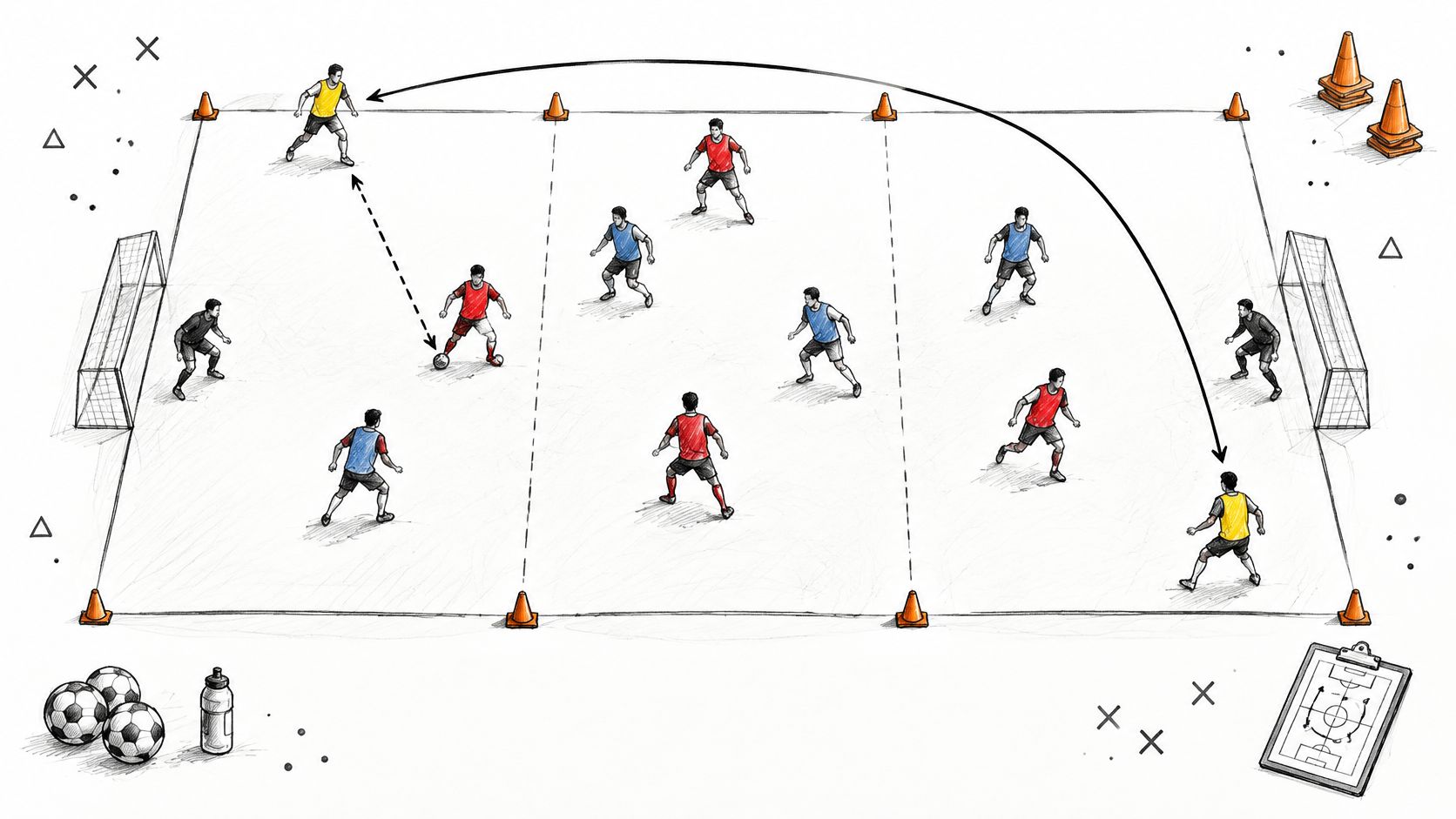
Score a pass into a target zone first. Then demand a pass to a neutral before the final zone. Add two touches, then a rule that the ball must switch at least once before a point. The last step removes the neutrals and asks for the same pattern without them. That is the transfer test. If the switch dies when the neutrals leave, the team was borrowing width rather than creating it.
Younger players need a larger area and more touches. Advanced players get smaller zones and a time limit on the switch. A hypothetical example is this 5v5+2 in 35m x 25m with three zones, inside a possession block aimed at switching play. Coach the runs off the ball in the far zone before you coach the pass. Mark every line so players can see the zone they are entering. Patterns for the far-side pass are covered in these notes on switching play.
7. Wing Play and Crossing Game (4v4 with Wide Attacks)
4v4, small goals, and two wide channels. The score that matters is a cross that leads to a shot, not a pass that merely reaches the flank. Players must recognise when the wide player should deliver, and when the runs in the box are on.
Use 30m x 20m and eight players. That length sits inside the FA range for 5- and 6-a-side, 25–50 metres long and 16–35 metres wide, on a rectangle whose touchline is longer than the goal line, as set out in the FA law for the 5-a-side playing area. The channels are extra lines inside that rectangle, not a new pitch.
Get wide early. Deliver when a teammate is in a finishing pocket, not when the wide player runs out of ideas. Rotate so the same two players are not the only ones crossing.
Point for the action: a cross that becomes a shot.
Entry rule: the ball must reach a wide player before the cross.
Recovery: one defender must get back into the box.
Touch limit: once the timing is stable.
Box numbers: a second attacker, finish within three passes.
Younger players get a larger area and may dribble into the channel. Advanced players cross from a marked zone and have less time. A hypothetical example is 4v4 in 30m x 20m with two channels, inside an attacking block. Show the run paths before the first cross, or the striker will arrive with the goalkeeper. Cones must stay visible, because a drifted channel teaches the wrong body shape.
8. Channel Duel Game (1v1 and 2v2 in Defensive Channels)
A defender protects a channel. An attacker tries to beat them and reach a target zone. The decisions are defensive. When do you engage, when do you delay, and when does the second defender cover? A mistimed tackle is a goal. A passive delay that never engages is also a goal.
Mark 20m x 15m and split it with cones, target zone at one end. Run 1v1 or 2v2, so two to four players per duel, with the rest resting and watching the next channel. Stay goal-side. Delay until the attacker's first touch is heavy, then step. If the duel is lost, the covering defender is already on the lane, not arriving late.
Repeat quality drops if you add bouts. In elite youth players, six repetitions of short 1v1 games showed external load falling across the sequence, with significant drops from around the third or fourth repetition depending on the protocol, in a Scientific Reports study of repeated bouts. Stop or rest when the duel turns into jogging. Late reps then train fatigue, not the tackle timing you came for.
Build from a 1v1 point for a successful defensive action, to a 2v2 in which defenders must talk before they engage. Add a second attacker who can join, then make the defenders play the won ball into a target zone. A neutral supporting the defence is the last layer, not the first. Younger players get a wider channel and more time. Advanced players get a narrower channel and a count.
A hypothetical example is 1v1 in 20m x 15m, one point for a clean defensive action, inside a defensive block that later joins a pressing game. Sketch the channels and the goal-side body shape before the first duel so the start position is agreed.
How the eight small sided games compare by players, setup and coaching focus
The eight games run in the order a session block runs. Possession games sit at the top, pressing games in the middle, and transition and defensive games at the end. Read the table that way and it shows which decision each game trains, not just what the pitch looks like.
Item | Decision Trained | Block | Main Coaching Focus |
|---|---|---|---|
Rondo (Possession in a Grid) | Which pass keeps the ball when pressure arrives | Possession | Passing, scanning, and first-touch decisions |
Four-Goal Game (Possession with Transition) | Keep possession or attack an open goal on the turnover | Possession to transition | Transition, width, and switching to open goals |
Box Game (Pressing and Winning Possession) | When the unit steps together and who covers behind | Pressing | Pressing, cover, and team compactness |
Pressing Trigger Game (4v4 with Pressure Cues) | Which cue starts the press | Pressing | Recognising pressing triggers and coordinating pressure |
3v2 Overload to Goal (Attacking Transition) | How quickly to finish before the defenders recover | Transition | Attacking quickly and using numerical advantage |
Positional Zone Game (5v5+2 Wide Overload and Switching) | When to switch play through the supporting players | Possession | Using width, creating overloads, and switching play |
Wing Play and Crossing Game (4v4 with Wide Attacks) | When to go wide and when the cross leaves the foot | Attacking | Crossing decisions, delivery, and timing runs into the box |
Channel Duel Game (1v1 and 2v2 in Defensive Channels) | When to step and when to delay | Defending | Defensive engagement, delaying, and covering |
Pair games from adjacent rows and the session holds together. A rondo warms the first touch, then the four-goal game asks what happens when the ball is won. The box game builds the pressing habit, and the trigger game names the cue that starts it. The 3v2 finishes the turnover the press creates, and the channel duel closes the block by teaching the defender who arrives too early or too late. Skip a row and the session still works. Skip the decision and it becomes eight unrelated drills.
Choosing the Right Small Sided Game for Your Session
Pick the game that matches the decision, then fix the area, the numbers, and the first progression before anyone crosses the line. A session block works best when the games connect: a rondo builds the possession habits the box game then tests under pressure, and the 3v2 extends the same picture into the moment after a regain. Running all eight in one evening usually means none of them is coached.
Check the grass against the format, including a safe edge. The FA's facility guidance sets accepted dimensions for small-sided pitches and recommends a run-off beyond the lines. A grid drawn into the run-off will ruin the first transition, so mark the working area inside it.
Change one variable at a time. If presses are late, name a single trigger before you shrink the pitch. If crosses float into an empty box, show the run before you add a touch limit. If the overload never finishes, move the recovery defender's start rather than adding a second rule. Write down what you will watch for: five passes, a switch before the goal, a regain inside the cue. Physiological strain can look fine while those actions fall apart.
Sketch the area, the goals, and the first running line before players arrive. On TFA Tactics Board, player positioning, the ball, passing arrows, running movements and coaching notes are free, so the picture can be ready before the rule is spoken. Players should see the picture before they hear it.
TFA Tactics Board is a browser-based planning board for the areas, goals, and cues in these games, with free player positioning, the ball, pass and run arrows, notes, and PNG export. The 11v11 full-size pitch format is free, while the 9v9, 7v7, 5v5 and training grid formats sit within the £9 membership, which also covers multiple saved boards and advanced drawing tools. Open TFA Tactics Board and draw the first grid before the cones go down.
Authored using Outrank