On Saturday morning, one team keeps bunching around the ball while the opposition finds space behind them. Start with a shape that helps players recognise their next decision, then adjust it to the group in front of you.
In 8v8, each team has a goalkeeper and seven outfield players, as set out in the Why 8-a-Side guide. A formation should make a specific problem easier to solve: supporting an isolated forward, opening a crowded midfield, protecting the defenders or recognising when to press.
The shapes below pair each formation with the decision players need to spot first. Use the worked practices and coaching cues to help them apply that decision in play. The 2-3-1-1 shape has seven outfield players, so it fits the 8v8 count; the section below corrects its label to 2-2-1-1.
Table of Contents
1. 3-3-1 (1 goalkeeper, 3 defenders, 3 midfielders, 1 forward)
The first decision is whether to support the ball or preserve cover. The 3-3-1 gives players clear defensive and midfield reference points, making it useful when the team becomes disconnected during build-up.
TeamStats' 8-a-side coaching guide identifies this shape as a practical structure for teaching compactness and positional coverage. Its limitation is the lone forward: possession can look tidy behind the ball while the striker remains outnumbered.
The following sketch is an illustrative coaching image, not a product screenshot or a verified positional reference.
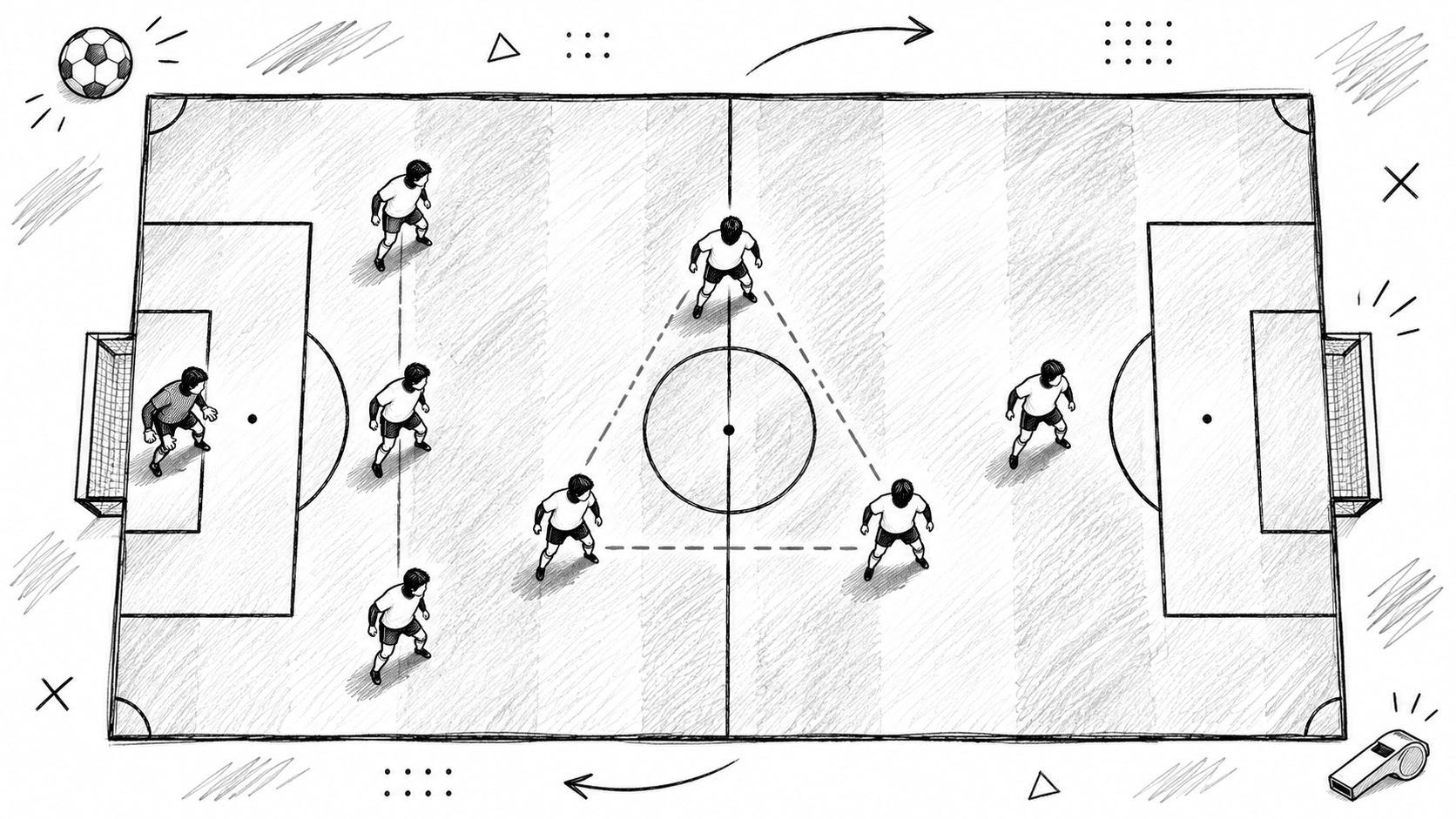
Coach connection before progression
Example practice: Use opposing 8v8 teams on the match pitch, restarting from the goalkeeper. The objective is to connect the defensive line with midfield without leaving the forward detached.
The goalkeeper finds the central defender, the outside defenders widen and midfielders offer staggered support rather than dropping onto the same line. The forward occupies an opposition defender while the nearest midfielder prepares to support the next pass.
Defensive cue. The back line moves together and preserves its gaps as the ball travels.
Attacking cue. A pass into the forward triggers midfield support, not spectatorship.
Progression. Allow opponents to press freely after players recognise the initial passing options.
Adaptation. Reduce pressing intensity for developing players and rotate midfielders into the forward role.
A connected practice matters more than rehearsing an unopposed pattern perfectly. These principles also fit the session-design approach in this guide to small-sided games in football.
2. 3-2-2 (1 goalkeeper, 3 defenders, 2 midfielders, 2 forwards)
Choose 3-2-2 when you want two forwards to create different problems. The first decision is whether one should drop towards the ball while the other threatens the space behind. If both make the same movement, the defence can deal with them together.
The back three provide cover, but the two midfielders must manage the width. If both move towards the touchline, the middle opens; if neither shifts across, the outside defender can be left without support.
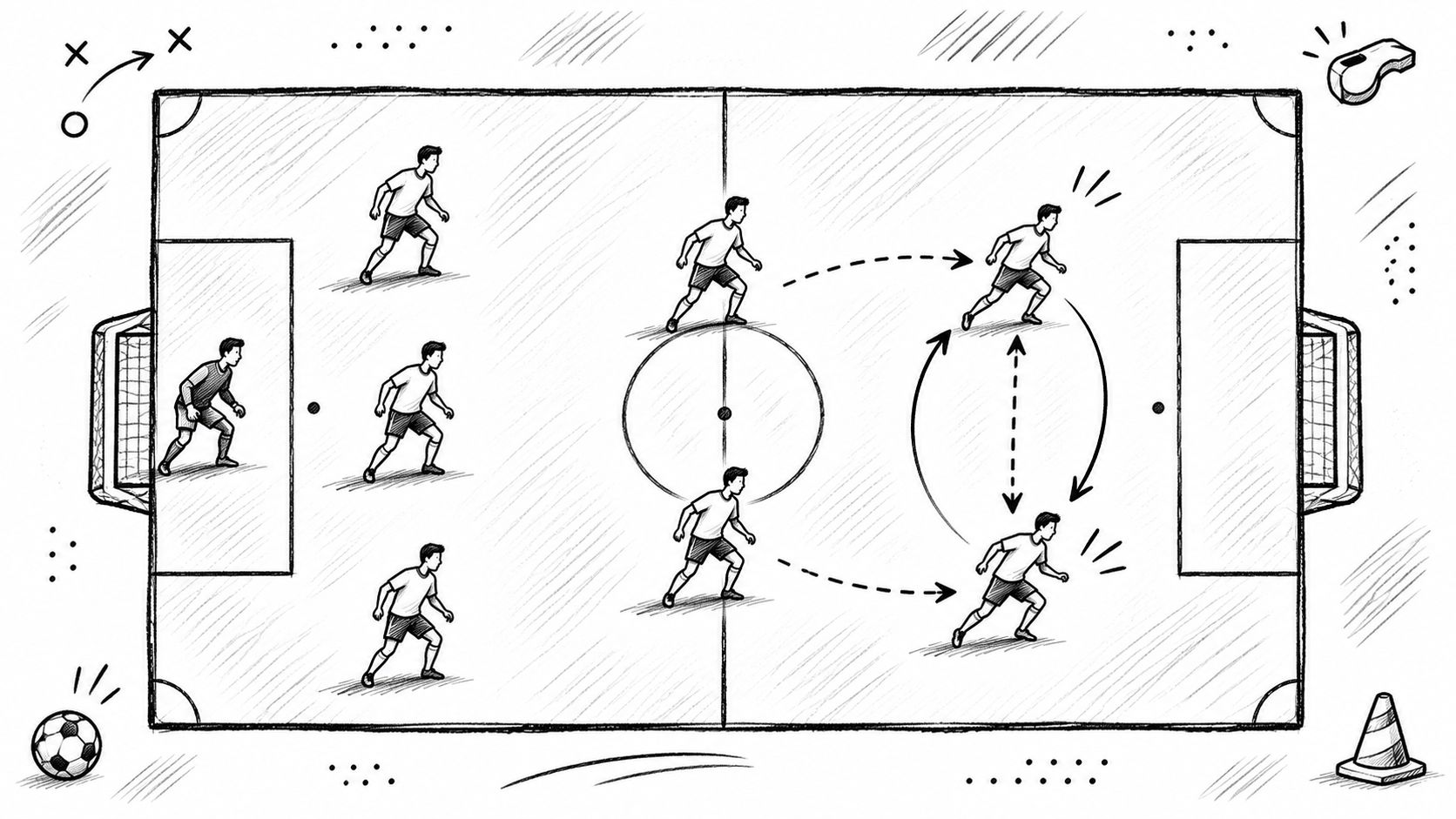
Give the forwards different jobs: one offers a short pass, the other threatens depth.
Build the partnership, then add the team
Example practice: Start with a 2v2 attacking game towards goal, with a server supplying passes from midfield. Ask the pair to recognise when one forward should receive short and when the partner should run beyond.
Progress to opposing 8v8 teams. A midfielder finds the dropping forward diagonally, while the partner threatens behind. The outside defender stays connected to the covering players rather than advancing automatically.
For developing players, give the receiver more space before defenders engage. For confident players, let defenders intercept the server's pass and counter immediately.
Depth still depends on local rules. The FA's small-sided football rules specify no offside. Under that framework, the covering defender must track a high attacker and protect the route towards goal rather than relying on an offside trap.
3. 2-3-2 (1 goalkeeper, 2 defenders, 3 midfielders, 2 forwards)
Choose 2-3-2 when the team needs clearer width and nearby passing support. The midfield line can stretch opponents while maintaining a central connection, but possession alone doesn't protect the defensive pair.
The critical decision belongs to the defender considering a forward step. Space ahead isn't sufficient permission: the ball carrier must be secure, the other defender must provide cover, and a midfielder must recognise the space being vacated.
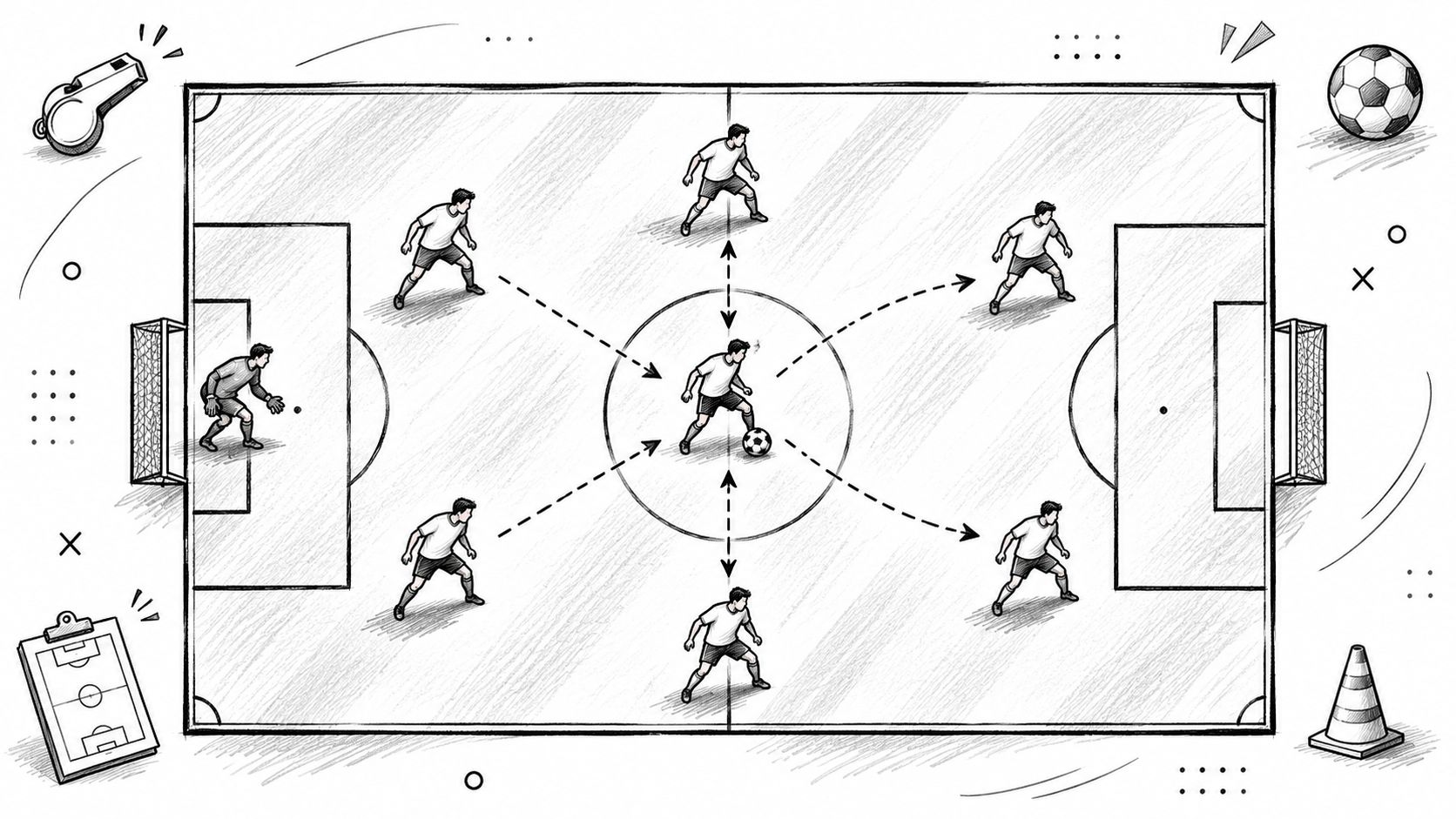
Make advancing conditional
Example practice: Play opposing 8v8 teams, with the objective of progressing through midfield while retaining protection against a counterattack. Start with normal play and pause only when a defender advances without cover.
A defender carries forward after an opponent leaves the central route open. The central midfielder moves into a covering position, the wide midfielders retain useful passing angles and the forwards separate to stretch the next defensive line.
Recognition cue. Secure possession first, cover second, advance third.
Progression. Encourage opponents to counter quickly after regaining possession.
Adaptation. Give developing players an unopposed restart before restoring live pressure.
Pitch width changes the difficulty of those recovery movements. The Special Olympics football regulations permit fields from 50 by 35 metres to 70 by 50 metres for their 7-a-side and 8-a-side formats. Coaches should therefore judge spacing against the actual pitch, not reproduce a diagram's distances regardless of context.
4. 2-4-1 (1 goalkeeper, 2 defenders, 4 midfielders, 1 forward)
More midfielders don't automatically produce better possession. The coaching problem in 2-4-1 is deciding who supports ahead of the ball and who stays underneath it.
A flat midfield can crowd passing lanes and leave the forward isolated. A diamond provides different receiving heights, but its rotations need clear cover: an advanced midfielder can't disappear towards goal while everyone else follows.
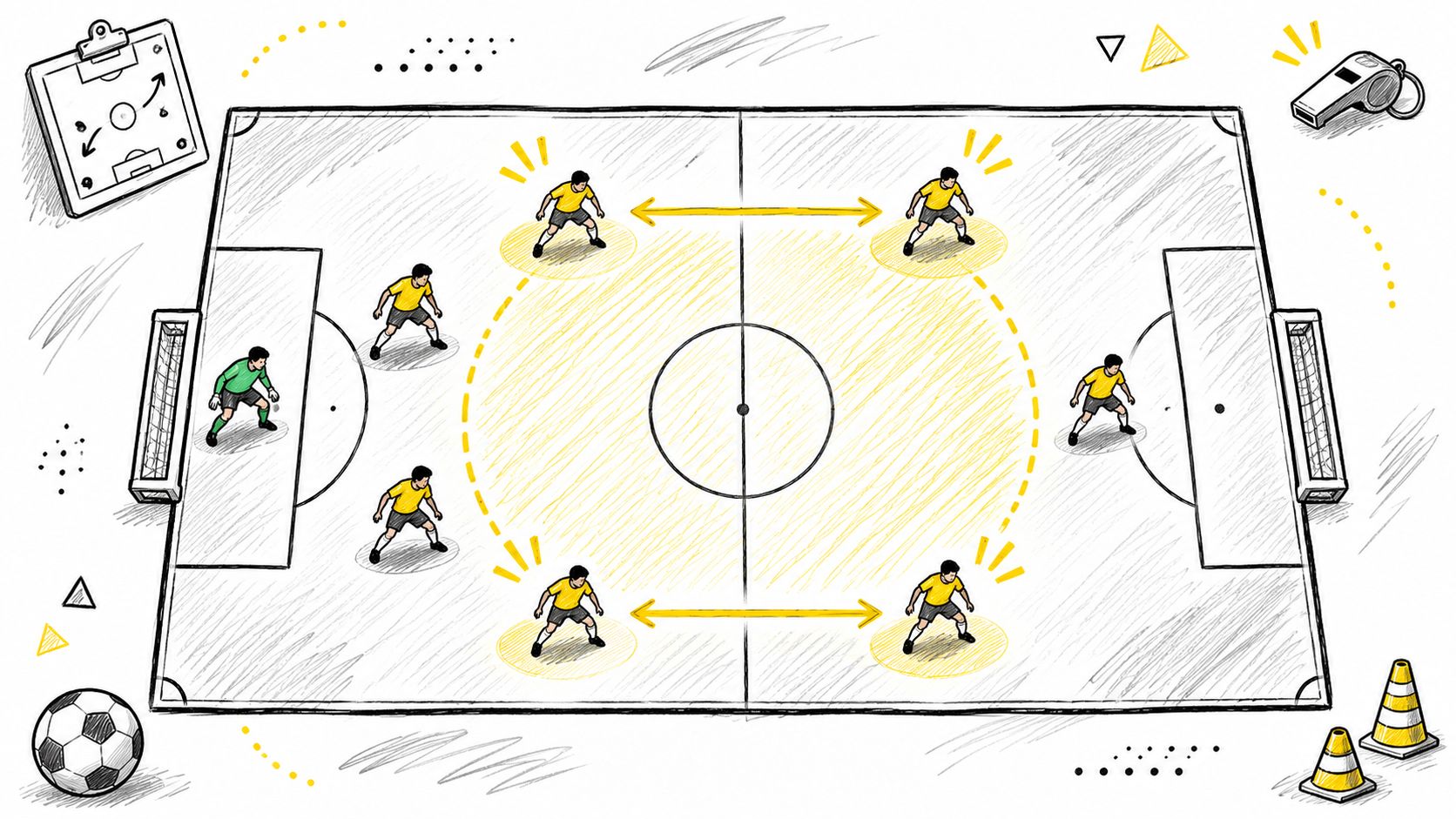
Example practice: Use opposing 8v8 teams and organise the midfield as a diamond. The objective is to connect with the forward and then support beyond, without removing the deeper passing option.
When the forward drops into a receiving pocket in front of the opposition defence, the nearest midfielder runs beyond. The deeper midfielder remains available for a return pass, while the far-side player narrows enough to help if possession changes.
Rotate without abandoning responsibility
Coaching cue. Replace the space a teammate leaves rather than following the ball.
Progression. Let defenders counter into the space behind an advanced midfielder.
Adaptation. Begin with fixed diamond roles, then introduce exchanges once players recognise the covering responsibility.
The trade-off is straightforward: midfield support improves only if players occupy different spaces. Otherwise, the team adds traffic around the ball and still leaves the forward alone.
The discussion of spacing in this 7-a-side formation creator guide provides a related planning reference, but coaches must adjust the player count and responsibilities rather than copy another format unchanged.
5. 3-1-3 (1 goalkeeper, 3 defenders, 1 midfielder, 3 forwards)
A 3-1-3 press is only as strong as the pass it leaves available. The first recognition is which route the front three are conceding on purpose, because the lone midfielder cannot cover the centre if the forwards surrender an easy inside ball.
The central forward screens the inside route while approaching the ball on a curve. A wide forward then engages the outside receiver, with the far-side forward narrowing to discourage an easy switch. The midfielder protects the central outlet rather than chasing whichever opponent appears nearest.
Pressing rule. When the first line is beaten, recovering towards the centre takes priority over another isolated chase.
Rehearse the escape as well as the press
Example practice: Use opposing 8v8 teams with goalkeeper restarts. The objective is to direct the build-up wide, then close the receiver's forward options while retaining central cover.
Begin with the opposition building through a designated side. Progress to unrestricted restarts so the pressing team must read the pass rather than anticipate a rehearsed sequence.
For developing players, slow the restart and identify the central outlet before play begins. For more capable players, allow an immediate counterattack after the pressing team regains possession.
The weakness appears when the forwards stay high after opponents escape. The midfielder cannot screen the centre, chase wide and support an attack simultaneously, so the escape often becomes a direct run at three defenders.
Offside rules also affect the back line's response. The Alberta Soccer Association's 8v8 law book applies offside only in the attacking third. Under that framework, defenders should treat the attacking-third line as the boundary for stepping up, checking the shoulder and recovering together, rather than assuming halfway-line offside applies everywhere.
6. 2-2-3 (1 goalkeeper, 2 defenders, 2 midfielders, 3 forwards)
A misplaced attacking pass reveals whether 2-2-3 is organised or merely ambitious. The first decision is whether the nearest player can delay the counterattack while teammates recover centrally.
The front line offers width and depth, but its starting position doesn't excuse defensive inactivity. A wide forward who remains beside the touchline after losing possession can leave a midfielder covering an unmanageable area.
Example practice: Play opposing 8v8 teams, with the objective of combining around the penalty area and recovering a protective shape after a turnover. The central forward occupies a defender, a wide forward receives and the nearest midfielder supports inside.
Give the midfield pair different jobs
When possession is lost near the flank, the closest player delays the ball carrier. The nearer midfielder supports that pressure only if the central route remains covered; the partner protects the pass towards goal.
Coaching cue. Pressure the ball when cover is available; recover centrally when it isn't.
Progression. Introduce a touch restriction for confident players, then remove it to test whether quick combinations persist.
Adaptation. Increase receiving space and allow extra touches when players struggle to scan before possession arrives.
Don't choose this shape to make players run harder. A systematic review comparing smaller and larger football game formats found greater improvements in linear sprint performance with larger formats, while smaller formats favoured change-of-direction ability. That finding concerns training formats, not proof that an attacking formation produces a particular fitness outcome.
7. 2-3-1-1 (1 goalkeeper, 2 defenders, 3 midfielders, 1 attacking midfielder, 1 forward)
The 2-3-1-1 spreads seven outfield players across four lines, and the shape stands or falls on one decision: can the attacking midfielder receive between the opposition's lines and turn, or must the ball come straight back? That player carries more freedom than anyone else on the pitch, and more chances to waste it. The forward helps by occupying a defender, staying high rather than dropping into the same pocket of space.
A playmaker needs space and passing angles, not permission to receive every pass regardless of pressure.
Choose this shape when you have a player comfortable receiving with their back to goal and a forward who holds that higher position with discipline.
Teach the scan before the turn
Example practice: Play opposing 8v8 teams, with the featured side set in a 2-3-1-1. The objective is to find the attacking midfielder beyond the opposition midfield without forcing passes through a closed lane.
The playmaker moves away from a marker before checking towards the ball. The forward stays higher to pin the deepest defender, and one of the midfield three offers a return pass if the turn isn't on.
Progress by allowing an opposition midfielder to track the playmaker closely. For developing players, reduce the immediate pressure on reception so the scan can happen; once the habit forms, restore live pressure and allow counters after interceptions.
The cue is scan before receiving, turn when space permits. An automatic instruction to face goal produces blind turns into defenders.
The midfield three carry the trade-off. When the attacking midfielder commits forward, their job is to hold position, keep a route back through possession open and protect the centre if the move breaks down. If two of them join the attack, a turnover leaves the two defenders facing three running forwards.
Seven 8v8 formations at a glance
Each shape asks players to recognise a different problem first: where to find support, which space to protect, or when to press. Use the coaching challenge column to choose the first decision to teach.
Formation | Defensive solidity | Attacking threat | Main coaching challenge | First decision players must recognise |
|---|---|---|---|---|
3-3-1 (1 goalkeeper, 3 defenders, 3 midfielders, 1 forward) | Three defenders and central midfield cover | Midfield triangles can support the lone forward | Keep the forward connected while maintaining width | Can a midfielder support the forward without leaving the flank unprotected? |
3-2-2 (1 goalkeeper, 3 defenders, 2 midfielders, 2 forwards) | Three defenders provide a stable base | Two forwards can combine and vary their runs | Stop the midfield pair becoming disconnected from the forwards | Is a midfielder free to support the forward partnership, or must the pair hold their positions? |
2-3-2 (1 goalkeeper, 2 defenders, 3 midfielders, 2 forwards) | The two defenders need cover, particularly in wide areas | Three midfielders can link play to two forwards | Protect the space behind advancing midfielders | Can the team cover a counter before both midfielders and forwards move ahead of the ball? |
2-4-1 (1 goalkeeper, 2 defenders, 4 midfielders, 1 forward) | The two defenders must protect wide spaces | Four midfielders offer passing options and support | Keep the lone forward connected while managing transitions | Which midfielder provides the forward's next option without leaving the defence exposed? |
3-1-3 (1 goalkeeper, 3 defenders, 1 midfielder, 3 forwards) | The back three can lack cover ahead of them | Three forwards offer pressing and attacking options | Prevent opponents from playing through the space around the lone midfielder | Should a forward press, or drop back to help protect the central lane? |
2-2-3 (1 goalkeeper, 2 defenders, 2 midfielders, 3 forwards) | Few players remain behind the ball | Three forwards can press high and threaten the final third | Coordinate recovery runs and central cover | When the press is bypassed, which forward recovers first and which midfielder protects the centre? |
2-2-1-1 (1 goalkeeper, 2 defenders, 2 midfielders, 1 attacking midfielder, 1 forward) | The back two need support from the midfield line | The attacking midfielder can link play with the forward | Keep the attacking midfielder and forward in separate spaces | Can the attacking midfielder receive between the lines and turn, or should the ball go back to supporting midfield? |
From Shape to Session Putting the 8v8 Plan on the Board
The right formation answers the coaching problem players face this month. A disconnected team may need clearer support in 3-3-1; an isolated attacking partnership may benefit from 3-2-2; a side learning controlled forward movement may use 2-3-2. None removes the need to recognise pressure, cover and space.
Start the diagram with the match shape, then map a realistic passage of play. Show the goalkeeper's first pass, the receiver's support and the player protecting against a turnover. A coaching diagram becomes useful when its arrows explain decisions rather than decorate positions.
Separate the starting picture from the decision
Choose the starting shape. Include the goalkeeper and check every player's responsibility.
Map the football action. Distinguish passes from runs and identify the opponent creating pressure.
Add coaching detail. Record the cue for advancing, covering or recovering.
Export and communicate. Share a clear image, then test the decision against active opposition.
TFA Tactics Board (Free Tactics Board), by Tactical Football Analysis, supports browser-based manual positioning, the ball, pass and run arrows, labels, player numbers, team colours, notes and PNG export without a software download. Its free formation library includes 4-3-3, 4-2-3-1, 3-2-5, 4-4-2, 3-4-3 and 5-4-1; an 8v8 arrangement can be positioned manually rather than treated as an available preset.
The £9 membership includes small-sided pitches, saved boards and advanced drawing, with member-only formations 3-3-2, 2-3-1, 3-2-1 and 1-2-1. Additional phases, zones, spotlights, focused pitch views and member sharing/presentation controls are paid tools, not free-board features. Board storage remains local to the browser, so coaches shouldn't assume cloud synchronisation.
Before publication or training, check the diagram's player count, positions and arrow meanings manually. Then test the chosen shape in live play and adjust the instruction players misunderstood, rather than changing formation after every mistake.
TFA Tactics Board offers a free core workspace for arranging players, marking passes and runs, and exporting a coaching diagram as a PNG. Visit TFA Tactics Board to map an 8v8 shape around a specific decision, or try the free board before the next session.