The floodlights are on, half the squad is still changing, and the notes on the phone still list five drills. None of them says what a player should decide when the ball turns over. A football training session plan that earns its place on the touchline starts from one decision, then checks two things: how long the ball rolls, and whether that decision shows up in the game. A long list of exercises is a weak score. A correct first pass can still finish without a goal, and a tidy-looking session can hide a behaviour nobody counted.
Table of Contents
Set One Decision Objective and Player Numbers
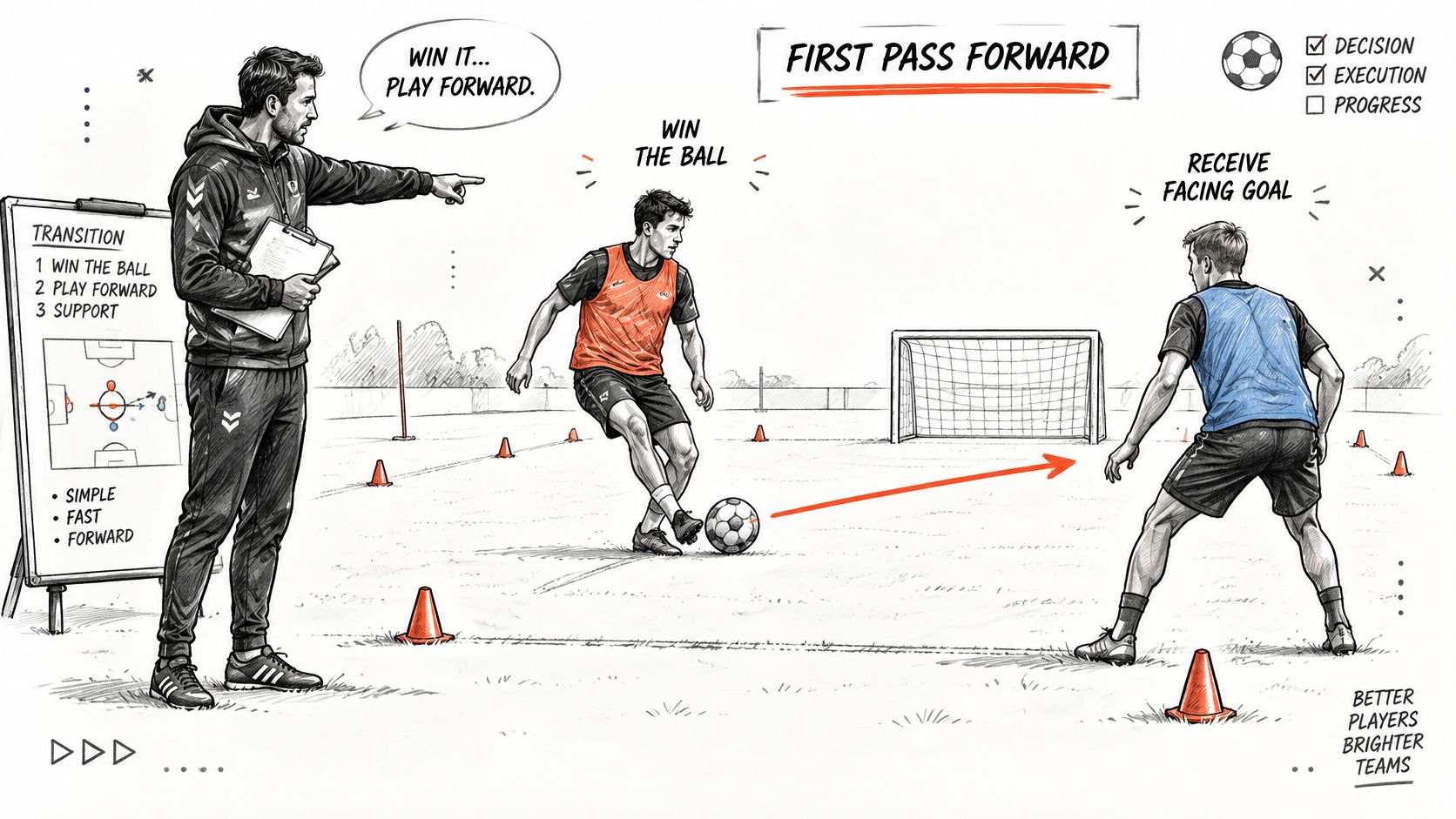
After winning the ball in the middle third, the first pass goes forward to a receiver facing goal within three seconds. That is a hypothetical objective, written as one sentence players can check. It comes from a match picture, not a favourite exercise: a team that loses the ball and cannot press, or a midfield pair that cannot receive between the lines.
Fix the numbers before the cones. A 4v4 uses eight active outfield players. Two neutral players bring the working total to ten. Goalkeepers, and the wider squad list, sit on a separate line so later area maths uses only the players who are in the practice.
The scoreboard is a poor judge. A review in the International Journal of Sports Science & Coaching points coaches toward objective behaviours such as regain time, successful pressure on the ball, forward passes after regain, or the percentage of possessions reaching the target zone. A correct decision can still end without a goal, so goals alone miss the point of the block.
Before anyone steps on, run a three-part test.
One sentence: the objective fits on a single line a player can repeat.
Visible early: the cue shows in the first minute of play, not only in a debrief.
Countable at the end: the chosen behaviour can be tallied when the session stops.
If the sentence fails any of those checks, rewrite it. Representative small formats carry that decision only when the numbers stay honest, which is why it helps to plan small-sided games in football around the same cue rather than around a drill name.
Pitch Size and Area per Player
Area per player (ApP) is pitch area divided by the number of active players. Mark the rectangle, count who is playing, then divide. Neutrals who are live in the practice count. Players sitting out do not.
A planning study in the International Journal of Sports Science & Coaching compares three validated examples, each run as four sets with repetition length from 7.5 to 12.5 minutes and five-minute passive recovery: 4v4 on 32 × 20 m (80 m² per player), 6v6 on 40 × 30 m (100 m² per player), and 7v7 on 52.5 × 68 m (255 m² per player).
Format | Pitch Size | Area per Player | Typical Use |
|---|---|---|---|
4v4 | 32 × 20 m | 80 m² | Dense pressure and frequent decisions |
6v6 | 40 × 30 m | 100 m² | Mid-sized groups with more running space |
7v7 | 52.5 × 68 m | 255 m² | Longer tactical actions and wider movement patterns |
What changes when the area moves
For the middle-third objective above, 80 m² per player packs opponents close to the ball. Pressure arrives quickly, turnovers come often, and the first forward pass has to be chosen under a short clock. That density suits the "within three seconds" demand.
100 m² on the 6v6 opens a little more running room. Support can arrive from wider angles, and the same forward pass is still urgent, but the receiver has a longer first touch to face goal. 255 m² on the 7v7 stretches the action. Players cover more ground, switches last longer, and the cue can disappear if the objective was a tight regain rather than a longer build.
Smaller ApP and fewer players raise pressure, transition frequency and decision density. Larger ApP creates more running space and longer tactical actions. Pick the row that matches the decision you are training.
A youth reference and the check
The same planning paper describes a controlled youth protocol: a 25-minute warm-up made of five minutes of jogging and locomotion, 12 minutes of football-specific drills and three minutes of progressive accelerations, then five 4v4 games with three-minute play and rest on pitches from 16 × 24 m to 24 × 36 m. Those boxes are tighter than the 32 × 20 m example, so the same 4v4 label does not mean the same problem.
Adjust in three steps. Mark the pitch. Count the active players. Check ApP against the objective before the first repetition starts.
Common error: a small-sided game does not automatically copy match load. Pair the plan afterwards with session-RPE or heart rate, and with the technical outcome you chose, rather than assuming the box did the conditioning for you.
Build the Timed Session and Sequence the Activities
A 60-minute football training session plan can be written as five blocks before anyone arrives. The Football Association's plan, do, review guidance asks for realistic, game-related practices that create frequent decisions, a connect-activate-demonstrate-consolidate sequence, and at least 70% ball-rolling time. On a 60-minute clock that is at least 42 minutes with the ball rolling and no more than 18 minutes for explanations, interventions and organisation.
Block | Minutes | Purpose | Ball-Rolling Time |
|---|---|---|---|
Connect and explain the decision | 5 | Name the objective and the cue players must watch | No |
Activate | 10 | Ball-rolling warm-up linked to the objective | Yes |
Demonstrate in a small-number practice | 15 | Isolate the decision with 2v2, 3v2 or 3v3 | Yes |
Consolidate in a game | 25 | Play the decision in a realistic setting with a scoring rule | Yes |
Review and set the next step | 5 | Ask players what they saw and why it mattered | No |
Total | 60 | Explanation and organisation take 10 minutes | 50 minutes |
The skeleton holds 50 minutes of ball-rolling time against the 42-minute floor, so it absorbs a short stop or two before the session fails its own check.
The same 70% test scales the template. A 45-minute session targets 31.5 minutes of ball-rolling time, a 90-minute session targets 63 minutes. Extend the demonstration and the game when the clock grows, and keep the connect and the review short regardless. When a session runs long, shorten the talk first and keep the game length. The game is where the objective behaviour gets its repetitions; the talk is where the minutes hide.
Order the activities around one cue
The FA's running-a-team guidance moves from a whole-group game to a small-number practice, using formats such as 2v2, 3v2 and 3v3, then back to a whole-group game. Start in the game so the decision is visible. Isolate the interaction while the picture is fresh. Return to the game so players have to recognise the same cue with more players and less prompting.
Keep each bout short. Stop the whole group rarely, and give one player a specific challenge rather than a lecture to twenty. If the first game already shows the forward pass within three seconds, the small practice can be brief. If it doesn't, stay in the 3v2 until the receiver's body shape is the thing players notice.
Set the area before players arrive, so the first ball is rolling inside a minute of them stepping on.
A hypothetical switch-of-play block
This worked example is hypothetical, built on the FA's four-goal practice. Play a 5v5 in an area split into two halves. Two goals sit at each end, one on either side of the halfway line, so each team has two attacking targets and two defending targets. Players are asked to keep both halves in their eyeline when they receive. A goal scored after the ball is switched into the other half counts as two instead of one.
The receiver's choice is the session. Exploit the far side now, or keep the ball, attract pressure, then switch. That is the same family of decision as the middle-third forward pass: scan, then play to the free side rather than the nearest foot.
Two adjustments cover most of what you will see. If the picture is messy, allow an unopposed switch so the far-side goal becomes obvious. If the choice comes too easily, require a switch before a team can score at all. Change one rule at a time, or the score stops telling you which rule did the work.
Add the minutes before you print
Add the ball-rolling blocks on paper: 10 + 15 + 25. If a coach's explanations inside the game push stoppages past eight extra minutes, the 50 slides toward the 42-minute line. Shorten the talk first and keep the game length. Confirm the game still scores the decision from the small practice: a switch worth two goals only helps if players must still recognise the cue they just trained. For drawing that sequence before the session, a soccer drill maker is a cleaner place to sketch numbers and arrows than a fresh sheet each week.
Adapt the Session for Ability and Readiness
One sheet for the whole squad usually fails the players who turned up. Write the adjustments as rules a coach can apply mid-repetition, first for ability, then for readiness.
Ability
A less experienced group gets an overload or a neutral, so the ball-side choice stays visible. A stronger group works in numerical equality, or under a tighter condition, so the same choice has to survive pressure. The numbers around the decision change; the decision itself does not, so every player stays on the sentence from the start of the plan.
The FA's constraint guidance treats pitch type (big, small, narrow or wide), markings, and the three Rs of restrict, reward and relate as the levers. To play through wide areas, use a wide pitch, mark the channels, reward a goal after a wide combination, and relate that rule to the match behaviour you want. When a group sits above or below the level the practice assumed, climb the regress and progress ladder already built into the activity sequence, one rule at a time.
A constraint should make the target decision more likely; if it only makes the practice harder, it is not doing its job.
The check is the behaviour, not the drill count. Watch the first repetitions for the cue: if the choice never surfaces, the group needs the overload before it needs more explanation.
Readiness
Ability changes the opposition; readiness changes the dose. Reduce volume and keep the objective. Swap a running repetition for technical work on the same cue. Give a player returning from injury, or carrying fatigue, a lower-load version of the same game rather than a different theme.
A paper on soccer monitoring and training characteristics indicates that weekly load should follow the match cycle: players may need exposure to at least 80% of match-related intensity three to four days before a match, reduced volume after heavy-load sessions, and compensatory work after match day for players who did not start. Symptoms, sleep and heart rate should move those rules, not a fixed prescription written on Monday.
Starters and substitutes can share the decision with different roles. In a hypothetical 60-minute session, a returning player joins the 4v4 with an extra neutral and completes one fewer sprint in the demonstration block. The forward-pass cue stays. Only the volume changes.
Draw and Share the Plan on the Free Tactics Board
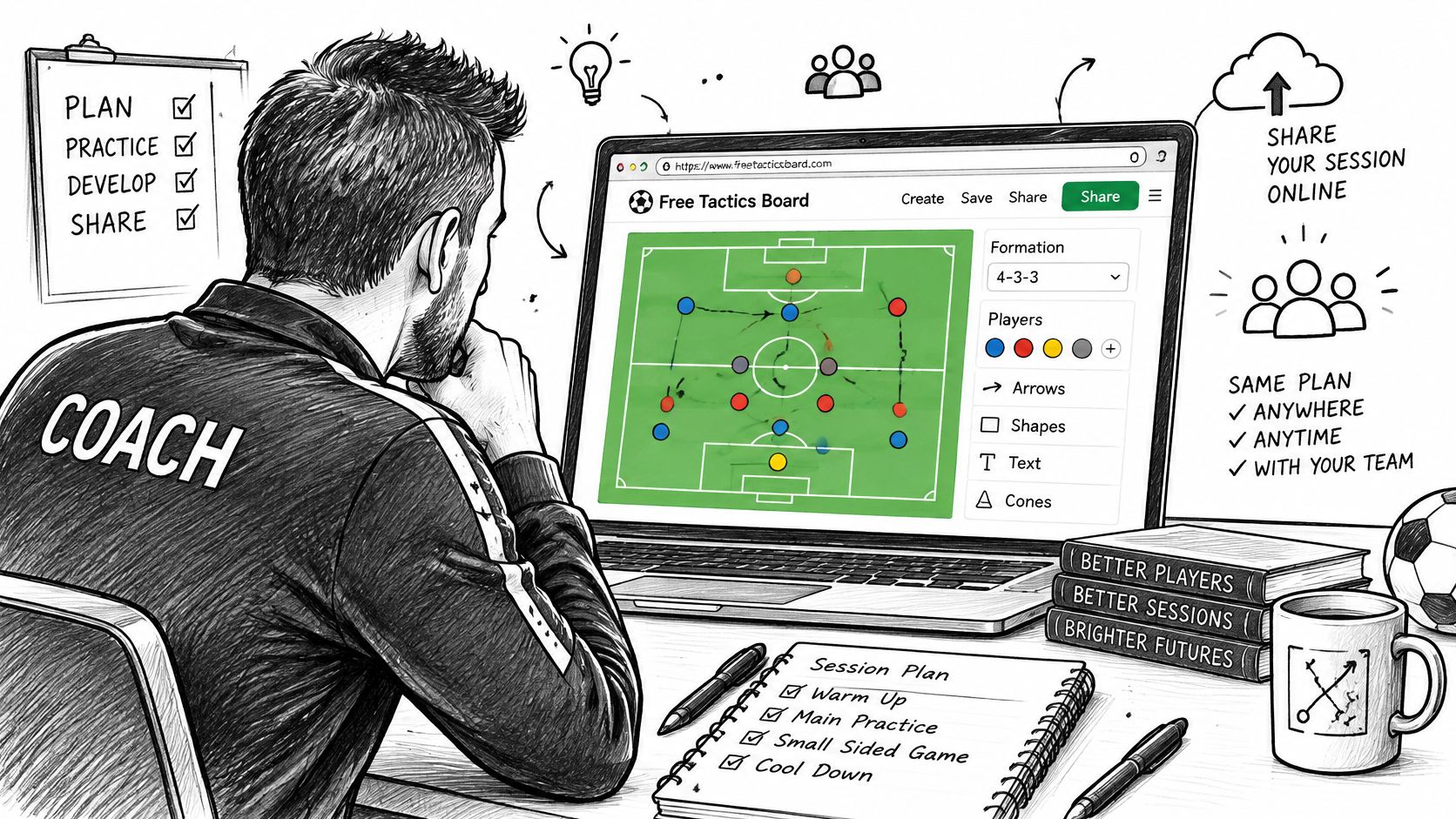
The diagram belongs in the browser, on the free TFA Tactics Board from Tactical Football Analysis. No software installation is required, and the board adapts to desktop computers, tablets and mobile devices, though a larger screen makes the planning work more comfortable. Using it follows four steps: choose the starting shape, map the football action, add the coaching detail, then export and communicate.
Free tools cover formation setup and manual player positioning, the ball, pass and run arrows, labels, player numbers, team colours, coaching notes and PNG export. The free formation library includes 4–3–3, 4–2–3–1, 3–2–5, 4–4–2, 3–4–3 and 5–4–1, and the 11v11 full-size pitch format is free. For this session, set the starting shape for the practice, mark the pitch area you calculated, place the ball, draw pass arrows for the decision only, add run arrows for the supporting movement, label each goal and write the cue in the coaching notes.
One decision per diagram. A board crowded with five passing options describes everything and teaches nothing. If the theme changes later in the session, draw a second board rather than layering arrows on the first.
What stays on a paid membership
Paid member tools are separate. The £9 membership adds dribbles, curves, shots, freehand drawing, zones, spotlights and tactical lines, plus pitch views for the defensive half, middle third or attacking half. Members also get 9v9, 7v7, 5v5 and training-grid pitches, member-only formations (3–3–2, 2–3–1, 3–2–1 and 1–2–1), additional phases for building a sequence across multiple pictures, and a library for organising saved boards. None of that is needed for the plan in this article. The free board covers it.
Boards are stored in the browser where they were created. Export a PNG to share the plan, and keep the editable board in that browser for the next session. Members have more options for moving work beyond that browser: shared sequences play through a link, and embedded lineups let viewers move players and reset positions without changing the original board.
Before the PNG goes to the group chat, check three things. Player numbers match the session notes. Arrows show only the decision being trained. Pitch markings match the area calculation. A diagram with the wrong shirt numbers teaches the wrong picture, so check positions and arrow meaning by hand.
Run the Session and Review the Plan Next Week
Treat the first run as information. Judge the change by whether the objective behaviour moved; a busy session and a full hour of exercises prove nothing on their own.
Count ball-rolling minutes against the template. For the 60-minute plan, the floor is 42 minutes. If the tally is short, cut talk before you cut the game.
Watch the game, not only the practice. Players can look sharp in a 3v2 and miss the same cue once the picture widens. If the decision dies in the game, keep the theme and add one game-like condition next time.
Record the behaviour you named at the start. Write the number down while it is fresh, on the same sheet or board you planned with. One count per session is enough to see the trend.
Change one constraint next week. A narrower pitch, a touch limit, or one extra defender. Several changes at once make it impossible to see which rule moved the behaviour.
Save the PNG with the date and the session number, then reuse that board for the same objective. A second week on one sentence beats a new theme every Tuesday.
A session where the behaviour didn't move needs one clearer constraint, run with the same objective and the same count.
The plan on paper is a starting point, and the squad's response decides the next session. Open the TFA Tactics Board and map next week's objective on the same diagram before the cones go down.