An assistant coach takes the printed sheet for the warm-up, looks at a pitch marked with twelve arrows, four cones and the note "possession, quick switch", and asks the obvious question. Which decision are the players meant to make, and when? The page shows movement. It doesn't show the problem the movement solves.
Sheets like that aren't a drawing problem. They're a layout problem. The coach who drew it knew what the session was for, but the page kept the knowledge in their head instead of on the paper. A session plan layout that holds up treats the sheet as a record of decisions: each block names the game problem, the information players will receive, and the thing an observer could count to know it worked.
Table of Contents
Session Plan Layout at a Glance
The fix is structural rather than artistic. Give every session the same seven fields, in the same order, read from top to bottom, and the page becomes usable by anyone who picks it up.
The gap this closes is well documented. Research on representative learning design argues that practices should preserve the informational and tactical demands of match play, and notes that session-plan guidance usually tells coaches to list objectives, coaching points and progressions without explaining how to represent decision density, pressing cues, body orientation or opponent behaviour. A template that asks for the decision first, and the diagram second, forces those details onto the page.
Field | What to Write | Example Entry |
|---|---|---|
Objective | One observable decision players should make | Switch play to the free side after the near side is pressed |
Players and format | Squad size, groups and pitch size | 16 players in two groups of 8 on a 60 by 40 m area |
Starting organisation | Positions, ball and goals numbered to the squad list | Team numbers 1 to 8 and 9 to 16, ball with number 2 |
Activities in order | Named blocks with minutes and purpose | Activation 15 min, integrated practice 45 min, applied game 20 min |
Constraints and progression | Rules that change difficulty and the trigger for change | Two touches for 10 minutes, then free touch |
Success criteria | What counts as the target achieved | Three successful switches in five minutes |
Coaching cues | Short phrases for verbal emphasis | Look before you receive; switch when the far side is open |
The order isn't arbitrary, and most templates leak at this point. The objective decides the starting organisation, the organisation decides which activities are possible, and the activities decide what the success criteria can realistically measure. Move one field out of sequence and the chain snaps. A plan with "possession" in the objective box and three unopposed passing drills below it has already become a drill list, whatever the heading says.
Use one test before drawing anything: could another coach run this session from this page alone, without asking a question? If not, a field is missing or vague, and the missing field is almost always the objective or the success criteria.
How to Sequence Objectives and Activities
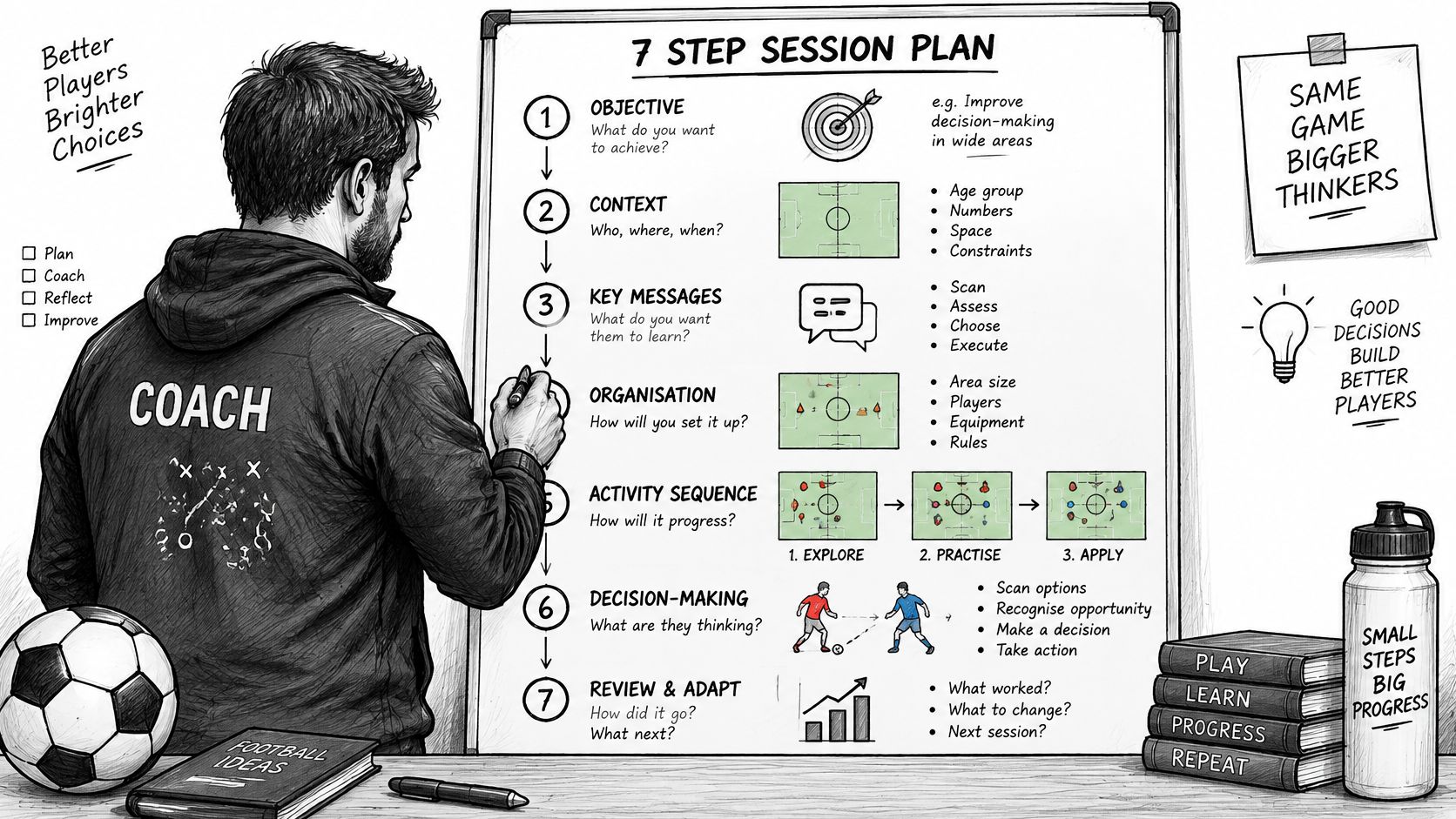
Sequence after the objective, never before it. These seven steps run in order, and each one constrains the next.
Seven Steps From Decision to Diagram
Write one observable decision. "Switch play to the free side once the near side is pressed" is a decision a coach can watch. "Improve possession play" is a wish.
Choose the applied game first. Keep player numbers and pitch area close to the match context, because that game is the only block that shows whether the decision transfers.
Work backwards into an integrated practice. A 4v4 build-up with two goals keeps the same pressure and decision points at a smaller scale.
Add a low-complexity rehearsal only when the movement pattern is missing, and keep it short. Most groups don't need it, and using it anyway pulls the decision out of the session.
Attach a transition condition. A team that wins the ball must attack one of two goals within six seconds, for example, so the block teaches the moment after possession changes as well as the moment on the ball.
Define success before drawing arrows. Three successful switches in five minutes, or a time to penetrate, measured by an assistant with a stopwatch and a tally.
Read the sequence left to right and check that every block depends on the one above it. Any block that could be swapped out without affecting the next one is decoration.
The common slip sits between steps 1 and 2. Coaches often start with the drill they enjoy running and only later hunt for an objective to hang on it. Research into high-performance team-sport coaches' planning identified activity design, sequencing and contextual constraints as the three planning priorities, and found recurring weaknesses in explicit learning intentions, session sequencing and small-sided-game design. The weakness isn't laziness. It's the order of work.
Sequencing test: players can explain the decision in the applied game without being told what to do.
Reading the Plan Through the FA Learning Cycle
The four stages of the FA Learning Cycle, connect, activate, demonstrate and consolidate, map onto the same sheet without adding blocks. Connect is the objective plus what players already know. Activate is the arrival game or integrated practice that poses the problem. Demonstrate is a short look at the players' own solutions. Consolidate is the applied game.
Take a hypothetical build-up session. The decision is when a centre-back splits the first line or recycles instead. Players meet it in a small-sided arrival game, work it in a directional practice, watch a thirty-second demonstration built from what they produced, then play a game that keeps the same distances and opposition. The sheet looks the way a well-made lesson plan design looks, with the outcome written before the activity and the check written before the teaching.
How to Split Session Time Into Blocks
Most coaches assume the diagram is the plan. The clock disagrees. A study of 20 Maltese under-12 and under-13 training sessions found that practices averaged 90 minutes (standard deviation 3.78), that transition activities took the largest share at 36.15% (SD 2.35), that game-based activity accounted for 34.70% (SD 3.26) and drill-based activity 29.77% (SD 3.38). The three shares come to roughly 100%.
Read that carefully. The 36% is time inside transition practices, not setup that leaked between drills. It is football being played, taught and rehearsed as a transition. Still, it means nearly two-thirds of the observed session went on transitions and games rather than isolated drills. The same analysis summarises earlier work across 83 sessions at professional club youth academies in England, Germany, Portugal and Spain, where games-based activity made up 62% of sessions and about 17% of total duration, roughly 18 minutes, was spent in transitions when players were not in drills or games.
What That Means for the Sheet
The practical conclusion is a separate transitions-and-resets block, written in as a line with a minute value. Waiting that is invisible on paper gets discovered on the grass, usually by the players standing in a queue.
For a hypothetical 90-minute session, the split might look like this.
Block | Minutes | Purpose |
|---|---|---|
Activation | 15 | Rondo that rehearses the target decision |
Integrated practice | 45 | Opposed practice with the tactical problem and constraints |
Applied game | 20 | Game in which the target behaviour is observable |
Transitions and resets | 10 | Setup, regrouping and rotating groups |
Total | 90 | Must equal the session length |
Add the minutes and confirm they equal the session length before anything else. Mark which blocks are opposed, since that determines how many balls, bibs and goals the assistant needs. This table is an example split, not a measured session.
The rule that saves the diagram: write the minutes first. A picture that will not fit the timeline gets rebuilt on the grass, in front of the players.
Adapting Each Block Without Losing Its Objective
Adaptation goes wrong when a coach changes three things at once and can't say which one moved the behaviour. The FA's grassroots coaching guidance sets out four levers under the STEP principle, space, task, equipment and players, and they give a progression system that survives contact with a real group.
Work through a hypothetical 4v2 keep-ball practice. Progress only when players consistently receive side-on and play away from pressure. Then change one lever.
One Lever at a Time
Lever | Make It Harder | Make It Easier | Record |
|---|---|---|---|
Space | Narrow the playing area | Widen the playing area | Pitch dimensions in metres |
Task | Require a forward pass before scoring | Remove the forward-pass rule | Successful forward actions per block |
Equipment | Limit touches to two | Allow three touches | Touches per possession |
Players | Add a neutral defender | Add a supporting player | Overloads and underloads reached per phase |
The plan states the starting organisation, the trigger for changing the challenge and the intended player behaviour, in that order. "When the two defenders win the ball twice in a row, add a third" is a trigger. "If it's too easy, make it harder" is not, because two coaches will read it two ways.
Ability moves in both directions. For less experienced players, widen the space or allow the extra touch while keeping the same decision intact. For more experienced players, narrow the area, limit touches or introduce the neutral player. Every one of these adjustments is an example, not a measured result, and each should be written into the constraints field before the session rather than improvised at the side of the pitch.
Record one number per block. A coach who writes down eight successful switches in the first block and three in the last has evidence about fatigue, difficulty or the constraint, and the next coach inherits it.
An adaptation that removes the decision has stopped being the session the plan describes. If narrowing the area means players can only clear the ball, the block now trains clearing.
Drawing Pitch Diagrams That Show Movement and Cues
A diagram that is talked through carries more than a diagram alone. In a 2022 study of soccer instruction, 80 female university students with an average age of about 20 worked through four kinds of multimedia material, and coordinated visual and verbal cues produced a significant improvement in immediate recall of complex tactical scenes (p = 0.03, effect size d = 0.53), sustained in delayed recall (p = 0.02, d = 0.85). The study's practical recommendation was that coaches verbally emphasise the relevant game action while visually emphasising the corresponding arrow.
That pairing is what turns a picture into a decision record. The drawing shows the game problem and the movement that solves it; the cue names what the player should notice while it happens.
Five Conventions Worth Keeping
Number players to the squad list. If the plan says number 6 steps in, the diagram's number 6 has to be the same player.
One colour per team, a separate colour for the ball and cones. Two colours plus a ball colour is enough. A fifth shade adds doubt.
Separate passes from runs by arrow style or a short label. The reader shouldn't have to guess whether a line means the ball or the player.
One diagram per phase. Four clean pictures beat one crowded picture of the whole session.
Put the coaching cue beside the arrow it belongs to. The spoken emphasis and the visual emphasis then match, which is what the recall findings support.
The free TFA Tactics Board handles the diagram mechanics in a browser, with membership adding phases and focused pitch views. It adapts to desktop, tablet and mobile, though a larger screen gives a more comfortable planning workspace. If you are still deciding what to draw in, this guide to choosing a soccer tactics board app covers what to look for.
Every diagram needs a manual check before it reaches players. Confirm the numbers and positions, trace each arrow to its meaning, then read the cues aloud against the picture. A mislabelled arrow teaches the wrong movement with great clarity, and a cue parked beside the wrong line does the same.
Communicating the Plan and Keeping a Copy
The same sheet has to reach players who take it in differently. The FA describes football environments as potentially loud, fast and reliant on abstract instructions, and recommends working with neurodiversity in football through short concrete steps, visual demonstrations, clear schedules, advance warnings before whistles and, where needed, a quiet reset area.
That doesn't need a second plan. It needs six lines under the main fields.
Six Lines Under the Fields
Visual agenda: block names and minutes from the timing table, shown before the first whistle.
Key wording: the coaching cues already chosen, written exactly as they'll be spoken.
Expected sounds: the whistle for a reset, the call for a switch, and a warning before either.
Demonstration point: who shows the movement, and for how long.
Rest and reset: where the quiet area is and when a player may use it.
A copy outside the browser: the TFA Tactics Board autosaves in the browser it's used in, so export a PNG or keep a written sheet for the folder.
More arrows don't automatically mean more clarity. For some players, less on the page works better, which is why a coach-facing detailed view and a player-facing simplified view of the same objective earn their place. Anyone starting the first diagram can build it on the free tactics board and export it before the session.
TFA Tactics Board gives coaches a browser-based pitch for exactly this job: position both teams, add the ball, draw passes and runs, and write the coaching cue next to the arrow it belongs to, then export the finished page as a PNG for the folder, the presentation or the group chat. The free board covers player positioning, passing arrows, running movements, coaching notes and PNG export with no download, while member tools add extra phases, zones and animated movement for plans that need more than one picture. Build the first diagram for the next session on TFA Tactics Board.