Training starts in twenty minutes. The bibs are out, half the balls need pumping, and the session still lives in your head: a warm-up, a game, something on switching play, a finish. Two assistant coaches ask what the middle block is. You explain it twice, slightly differently, and the players hear neither version.
A sports session planner fixes that. It is a set of linked blocks, each with a time, a player number, an area, a scoring rule and a cue, plus a picture that shows the decision. The linking is what matters, because ball time is the check: if a plan cannot say how long the ball is rolling in each block, it is a drill list wearing a planner's name. The audience for that clarity is young. FIFA's global participation count puts football's playing population in the hundreds of millions, and the clear majority of registered players are under 18, so most plans get delivered to players who copy what they can see. Roles, spacing and movement have to be stated plainly enough to survive a cold Tuesday night.
What follows is one complete plan, the routine that built it, and the checks that keep ball time honest while the same plan stretches for stronger players or shrinks for a heavy week.
Table of Contents
A 60-Minute Session Template at a Glance
Six blocks, twelve players, half a 3G pitch, a theme of switching play. This is an example session, and every section below refers back to it.
Example blocks for a 60-minute switching-play session
Block | Purpose | Example length |
|---|---|---|
Arrival activity | Ball-based warm-up linked to the theme | 10 min |
Conditioned game | Forces a switch of play before scoring | 15 min |
Coached practice | Teaches the behaviour in a repeatable pattern | 10 min |
Short, sharp physical section | Adds intensity linked to the theme | 5 min |
Final game | Tests transfer with the condition removed or made harder | 15 min |
Warm-down | Settles players and reviews the coaching cues | 5 min |
Total | Example 60-minute session | 60 min |
The order is teach, test, return. The arrival activity introduces the theme; the conditioned game puts it under pressure; the coached practice slows it down; the final game tests whether it survived.
The arrival block is not a queue for a warm-up. Twelve players, one ball each, a 30 by 20 yard box, no scoring, and two cues repeated until they're dull: first touch out of the feet, and a look over the shoulder before the ball arrives. The conditioned game gives the theme teeth. Six against six on 45 by 30, where a goal only counts if the ball has travelled from one wide channel to the other first. Cues: the far winger holds width until the ball moves, and the midfielder scans the far side before the first touch.
The coached practice shrinks it: 5v3 in a 30 by 25 zone with a gate on the far side, starting unopposed and adding passive pressure once the movement is clean. The five-minute physical block follows, and it should look like the theme rather than a fitness session, with three or four sharp accelerations to reach a switch and a walk back. The FA guide to managing grassroots football recommends this overall shape, a warm-up, a conditioned small-sided game, work on an aspect of match play, a short sharp physical section, another small-sided game and a warm-down, with practice blocks of roughly 10 to 20 minutes and larger numbers early in a training block so the ball does much of the conditioning.
That physical block is also the natural home for prevention work. A 2025 cluster-randomised analysis of the coach-led FUNBALL programme found severe injuries fell by 49% overall and by 63% during training, with balance, core stability, eccentric hamstring work, glute activation, plyometrics and sprinting among its components.
Rebuilding the template for a different length
Keep the theme constant and resize the blocks within the 10 to 20 minute range. A 45-minute session loses the coached practice and shortens both games; a 90-minute session doubles the conditioned game and adds a second coached block on the opposite behaviour. The final game and the warm-down stay where they are, because transfer and review are the two things that get dropped first when time is tight.
How to Build a Session in Six Steps
The template is one arrangement of a routine that works for any theme.
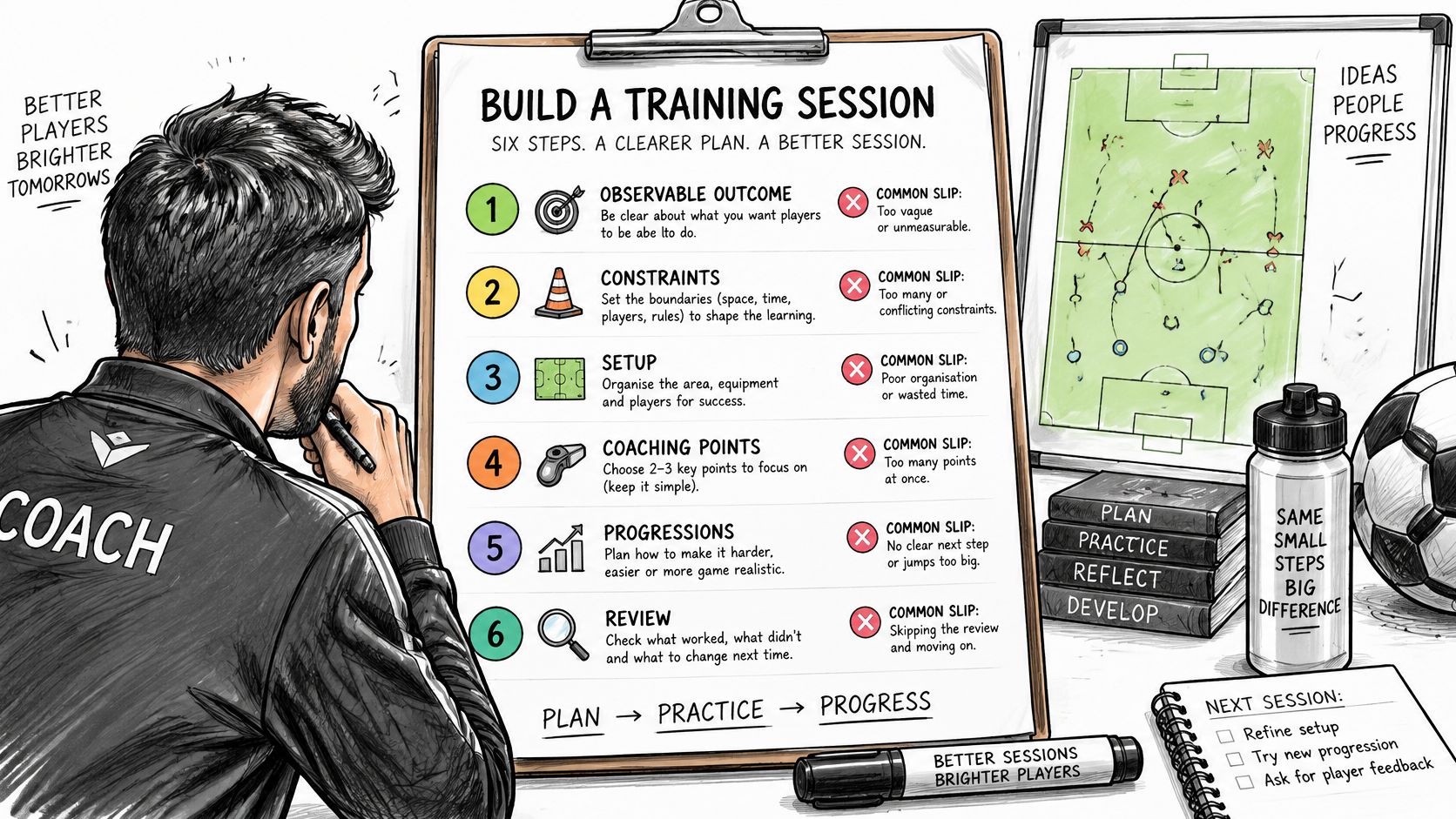
Write the observable outcome in one line. "Players switch play within three passes when the far-side winger is free" can be watched and counted. "Better possession" cannot. Describing a feeling rather than a behaviour is the first slip.
Choose a representative game format. Most themes belong in a conditioned game rather than an isolated drill, because the behaviour has to survive contact with opponents. The trap is reaching for whatever game the group ran last week instead of the one the objective calls for.
Set two or three constraints that amplify the target. A touch limit, a switch-before-scoring rule, a numerical overload. Keep the number low: with four rules running at once, players can't tell which one is doing the teaching.
Prescribe exposure and recovery. Minutes per block, repetitions of the action, rest between blocks. Letting a good practice run until it dies turns a sharp stimulus into a slow one.
Monitor whether the stimulus happened. Count the switches, track how long the ball stays in play, or stop the game and ask two players what they saw. A plan that's never checked becomes a ritual.
Modify the next block on what happened rather than on what you wrote. A case study of iterative session design followed a youth coach and their squad over a run of weeks and found three recurring influences on planning: how players responded to the proposed practices, external disruptions such as absences, and the work of connecting short-term activities to longer-term goals.
If you can't say what a player will do differently by the end of the block, you have written a drill rather than a session.
Step two carries the biggest trap. Research on small-sided games shows that reducing player numbers and increasing relative pitch area generally raises exercise intensity, while larger areas lift high-speed running without necessarily reproducing match-level sprinting, and transition games create very high locomotor demands. A 4v4 label is not a workload prescription. Counting three switches in a block against a target of six gives you a reason to widen the pitch, add a floater or shorten the area next block.
Choosing Player Numbers and Practice Formats
Player numbers are the fastest lever a coach has, because they change the decision problem without touching the theme.
Practice formats and the decision each one trains
Format | Decision it trains | Typical use in a block |
|---|---|---|
2v1 | Support, disguise and finishing | Isolating one decision early in a block |
3v2 | Combinations and defensive cover | Introducing an overload to recognise the pass forward |
3v3 | Repeated involvement and transition frequency | Testing the cue once players spot the spare player |
4v4 | Positional relationships with frequent decisions | Checking whether the behaviour survives greater complexity |
The FA guidance on running a team puts 2v1, 3v2, 3v3 and 4v4 alongside individual practices, tag games, ball manipulation, target games, line-ball games, two-goal games and four-goal games. The list matters less than what it allows: the same theme can be studied at four different levels of complexity inside one session.
Take an objective of recognising when to pass forward. A workable progression, and this is a hypothetical example, starts with a 3v2 overload so the spare player is obvious, moves to 3v3 once players find that player without being told, and finishes in a 4v4 or larger game to see whether the behaviour holds with more bodies around. The number should follow the objective, not climb automatically each week.
Adaptations change the problem without changing the theme: pitch size, neutral players, target zones and the scoring condition. The FA's guidance on structuring practice for effective skill learning makes the companion point about variation, since manipulating pass distance, speed and direction, and letting practice resemble the range of variations a match throws up, produces better learning than repeating one identical pattern all block.
The small-sided games guide sets out a longer progression if the format question is the one blocking the plan.
One rule covers most cases: if players solve the task too easily, change the condition before adding players.
Keeping Ball Time High in Every Session
The most useful check on any plan takes two minutes and no technology at all. Set the session length against the time players spend moving with a ball.
Minimum ball-rolling time by session length
Session length | Minimum ball-rolling time (70%) | Time left for other work |
|---|---|---|
45 minutes | 31.5 minutes | 13.5 minutes |
60 minutes | 42 minutes | 18 minutes |
90 minutes | 63 minutes | 27 minutes |
The benchmark comes from the FA's England coaching framework, which sets a minimum of 70% ball-rolling time in every training session alongside realistic game-related practices, frequent games, practices that create many player decisions, transition elements and a carousel approach that keeps playing time high. A 60-minute session therefore needs 42 minutes of ball-rolling activity, leaving 18 minutes for demonstrations, questions, water breaks and moving between blocks.
Measure it. Note when each block starts and stops with a ball in play, then add the blocks up at the end of the night. Most coaches find the same three leaks: long coach-led explanations, queues for a single repetition, and players standing while one person takes a turn.
Fixes are cheap. Run a carousel so every player is working, choose games that generate decisions rather than isolated repetitions, and build the transition into the practice instead of stopping it. A grid of four mini-pitches with twelve players keeps everyone involved; a line of twelve waiting to shoot at one goal does not.
The distinction that matters: the diagram shows the decision and the movement. The plan has to guarantee the repetitions under realistic pressure. One is a reference, the other is the session.
Time last week's session and find the largest block where players were waiting. That block is the first thing to rewrite.
Adapting One Session for Different Ability and Load
One plan, written once, run at three loads. The assumption that a session belongs to a squad rather than to a set of individuals is where most planning fails, because a returning player, a substitute with limited minutes and a player carrying a heavy week all pay different prices for the same practice.
Three loads, one theme
The low-load version keeps the theme and stretches everything else: a larger area, one extra player per team, longer recovery between games. The medium version is the plan as written. The high-load version shrinks the area, adds a transition rule or extra repetitions, and keeps the scoring target intact so the decisions don't change with the fatigue.
Ability changes the constraint, not the theme
Beginners get a fixed number of touches, or an extra passive player to make the picture slower and clearer. Advanced players work with a two-touch limit or a switch-before-scoring rule that punishes the easy option. Nobody changes activity; only the conditions around the activity move.
Returning from injury and limited minutes
The returning player joins the low-load version and takes a passive role inside the same game, so the picture and the vocabulary stay identical to everyone else's. What the club's medical or physiotherapy staff advise overrides any load level written on the page.
The feedback loop is a rating of perceived exertion on a simple 1 to 10 scale, recorded after the session and compared with the load the plan intended. Intensity labels are estimates, so compare planned and reported effort rather than trusting the label. A 2025 survey of 235 football coaches found 93.7% monitored training load, yet 42.7% didn't monitor internal load and 21.7% didn't conduct fitness evaluations, with lack of resources the leading barrier for 74.5% of coaches.
A workable minimum stack needs no kit beyond a notebook: session duration, perceived exertion, attendance, position and one short wellness question, with GPS or heart-rate measures added only where the club already collects them. Multi-source monitoring matters because a single indicator misses fatigue, which is why tiered monitoring recommendations combine daily wellness, session-based load and periodic physical testing.
What goes on the plan is one line per block stating what changes at each load level. A player with a heavy recent workload moves to the low-load version even when the diagram looks exactly the same.
Mapping the Plan Visually on a Tactics Board
The written plan and the diagram do different jobs. The plan holds the timings and the numbers. The diagram holds the picture a player can copy in three seconds.
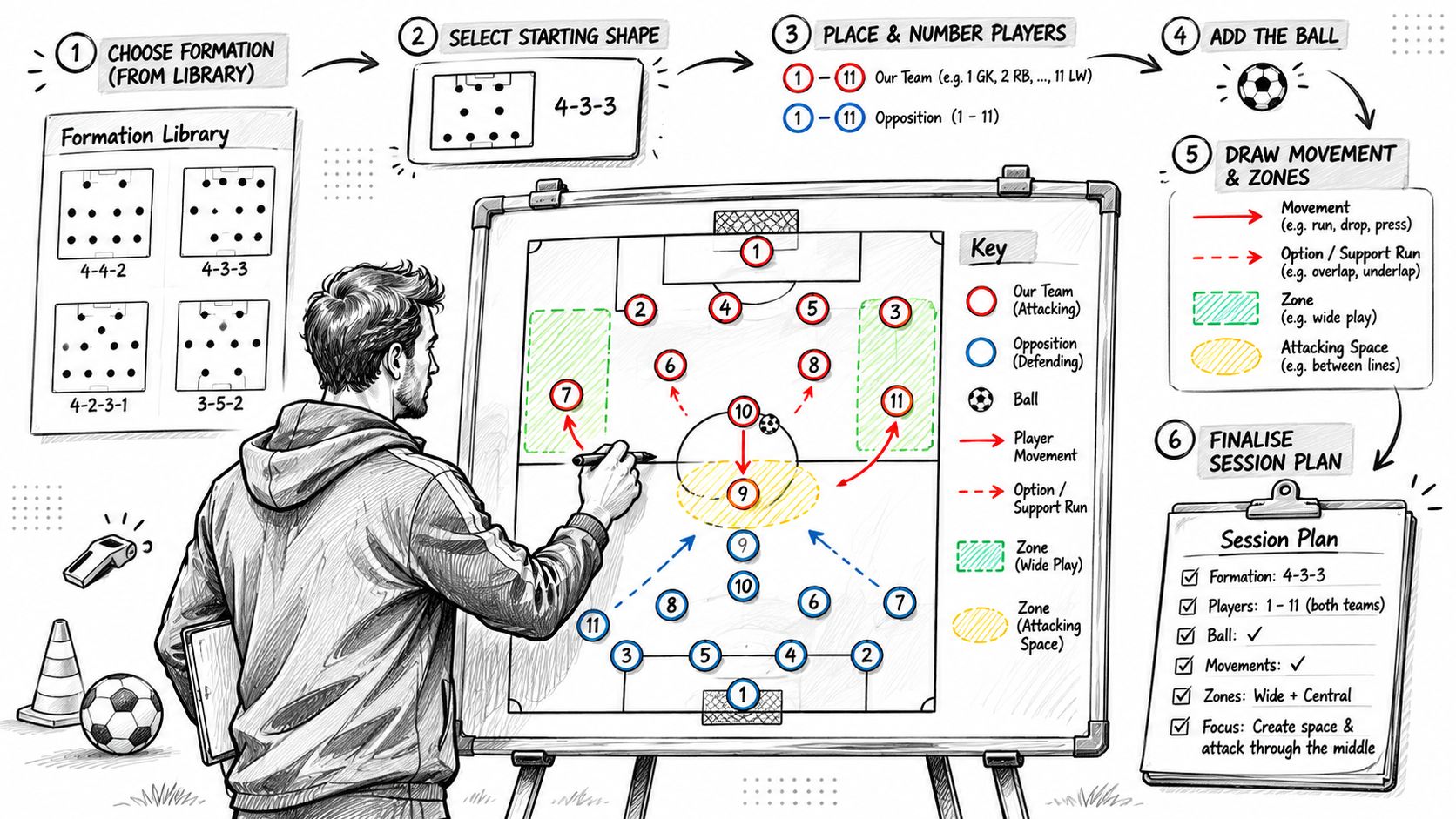
Start with the shape. The free formation library covers 4-3-3, 4-2-3-1, 3-2-5, 4-4-2, 3-4-3 and 5-4-1, and players can be dragged into position for both teams. Number the players to match the session notes so block two on the page is block two on the plan. Then place the ball and draw the pass and run arrows for the specific decision that block trains.
Keep one drawing per block and one cue per arrow, short enough to read at arm's length: receiver checks the shoulder before the pass, far winger holds width until the ball travels. Frames interpolate player movement automatically, so a two-frame sequence shows the run arriving on the pass rather than a crowd of arrows. The free tier covers everything a printed session sheet needs, namely positioning, the ball, passing arrows, running movements, notes and PNG export, while TFA membership adds the extra phases, zones and focused pitch views that longer sequences call for.
Boards save as named copies in the browser, so a plan drawn on the club laptop stays on the club laptop until you export the file or send a share link.
There's a worked walk-through of taking a board into a live practice in the tactics board planning guide.
Check every player number, position and arrow by hand before the plan is printed or shared.
Check the Plan Before Your Next Session
Five checks, run the night before, in order. Together they take about as long as filling the water bottles.
One objective, one behaviour.
A format that matches the objective.
Ball-rolling time of at least 70% once demonstrations and queues come out.
A load level and an adaptation on every block.
A diagram checked by hand for numbers, positions and arrows.
Then write the next session in the same order, objective through to revision, run it, and read the monitoring notes afterwards against the effort players reported. The checklist stops a weak plan reaching the grass. The review afterwards is what improves the next one.
Try the free board at freetacticsboard.com/#tactics-board to lay out one block, export the PNG and note what changed between plan and practice. The 11v11 full-size pitch is free. The 9v9, 7v7, 5v5 and training grid formats require membership, while positioning, the ball, passing arrows, running movements, notes and PNG exports all work on the free pitch.