A coach draws a neat 4 3 3 soccer formation on the board, names every position, and the team nods. Then the first pass moves, both eights push forward, a full-back overlaps, and one turnover leaves the pivot facing three runners alone. The starting picture wasn't wrong. The missing detail was what each player had to decide next.
Table of Contents
Positions and Jobs Across the 4-3-3
The base shape is simple. Four defenders, three midfielders and three forwards, with midfield split into one holding midfielder, often called the pivot, and two advanced eights. That structure only works when every role is written as an action, not a place to stand. A fuller breakdown of 11 on 11 soccer positions helps when players are learning neighbouring roles too.
Position | Common shirt number | Main attacking job | Main defensive job |
|---|---|---|---|
Goalkeeper | 1 | Starts attacks with a short or long pass | Organises the back line and communicates the offside line |
Right-back | 2 | Offers width or overlaps when the winger stays narrow | Covers space behind the advancing winger |
Right centre-back | 4 | Progresses the ball with passes into midfield | Holds the line and covers the pivot |
Left centre-back | 5 | Progresses and switches play | Covers the far side channel and space behind the left-back |
Left-back | 3 | Overlaps or underlaps when the winger holds width | Recovers to narrow when the winger drifts inside |
Holding midfielder (pivot) | 6 | Stays available behind the ball as a safe pass | Shields the centre-backs and screens the central lane |
Right eight | 8 | Moves into half-spaces and beyond the winger | Presses the opposition pivot |
Left eight | 10 | Supports the striker and links the lines | Protects central space and stays connected to the pivot |
Right winger | 7 | Holds width and makes inside runs | Narrows to block the switch of play |
Left winger | 11 | Holds width to receive one versus one | Presses the full-back's first pass |
Striker | 9 | Links play or pins the centre-backs | Presses the first pass and screens the pivot |
What the table can't show
Shirt numbers follow common convention and vary between clubs, teams and youth systems, so coaches should label diagrams with the numbers players wear. The key point sits underneath the table. A position is defined by what the player does when the ball moves, not by the dot where play starts.
The workload reflects that movement. In professional match data reported in the Coventry University position and formation study, central midfielders in a 4-3-3 covered more than 11% more distance than central midfielders in a 4-4-2. A separate synthesis in PLOS ONE reports forwards covered approximately 30% more high-intensity-running distance in a 4-3-3 than in 4-4-2 and 4-5-1. Those figures come from professional samples, so they describe demand at that level rather than a target for every age group.
Three roles cause most confusion. The pivot can look passive while protecting the most valuable space. The eights must choose between pressing, supporting and recovering. The striker must link play without dropping so deep that nobody threatens behind.
Where the 4-3-3 Came From
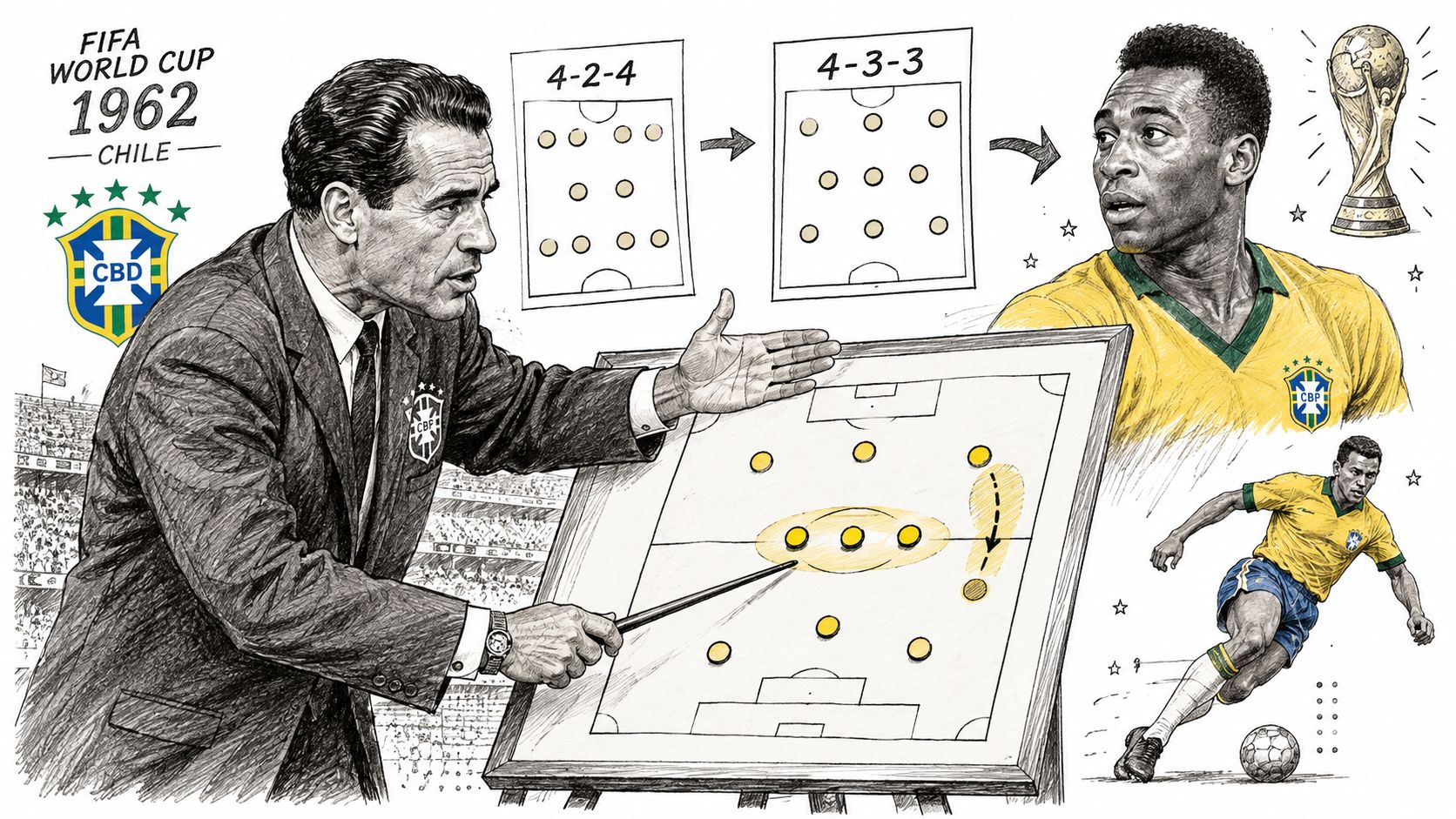
Brazil reached the shape by solving a defensive problem. At the 1962 FIFA World Cup in Chile, described in the FWC Times history of the 4-3-3 at World Cups, Brazil pulled winger Mario Zagallo into a deeper role. The change turned the 4-2-4 into a shape with three midfielders, adding cover centrally without giving up width or attacking numbers.
The deeper role worked as an early rest-defence rule: while Brazil's wingers pushed forward, a teammate stayed behind the ball so a counter-attack met a midfield line instead of open grass. The starting picture mattered less than what players decided once the ball moved.
Four defenders guard the goal, three midfielders protect the centre, and two wide forwards stretch the opposition beside a central striker, so the shape adds a body where opponents most want to play through.
From Brazil to Dutch Total Football
During the 1970s, Rinus Michels applied related principles with Ajax and the Netherlands. The Dutch teams at the 1974 and 1978 World Cups spread ideas built on positional interchange, pressing, fluid movement and collective responsibility; the 1974 side reached the final.
Interchange applied the same idea across the whole midfield. When one player stepped out of his zone, a teammate filled it, so the centre never emptied and the pivot never faced a counter alone.
Three midfielders create natural passing triangles and wingers hold width, which helps explain why the shape later underpinned possession football at elite clubs and national teams.
Historical success proves the shape can work. It says nothing about whether the shape suits a given squad. A famous lineage does not press, cover or finish; players still make the distances and decisions work against a specific opponent.
How the Shape Builds Play in Possession
Build-up starts with a safe base. The pivot stays available behind the ball for the centre-backs, giving the team a reset pass when pressure closes forward lanes. The eights can move higher or wider one at a time, since both advancing together empties the centre. If one eight goes, the pivot or the ball-side full-back secures the next pass and stands ready for the counter-attack. The starting picture matters less than what each player decides once the ball travels.
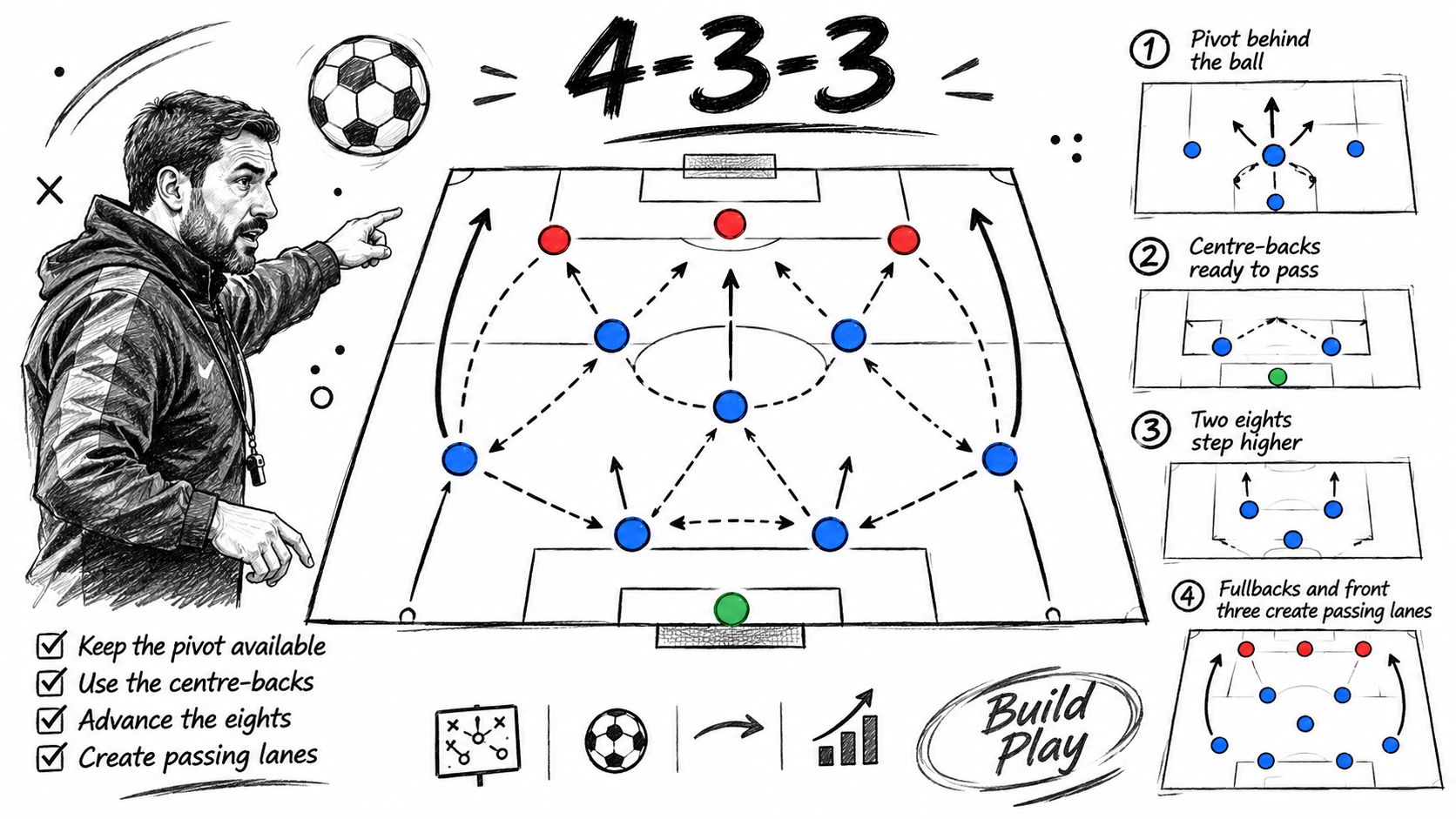
On each side, the full-back, eight and winger form a wide triangle. The ball carrier gets a forward option, a supporting option underneath and a route back inside. Good triangles let a team play around pressure instead of forcing one long pass. They collapse the moment all three players stand in a straight line, because one defender can then mark the whole lane.
Read the full-back before moving
Wingers have a two-part job. First they hold width to receive in the final third and stretch the back four. Then they make inside runs once the ball, the eight and the full-back create the right conditions.
Recognition point: check the opposing full-back's hips and starting position before choosing outside or inside. The movement follows the defender's position before the arrow.
If the opposing full-back stays narrow, the winger receives outside and attacks one versus one. If that full-back travels wide, space opens inside for the eight, an underlapping full-back or the striker. When the winger moves in, someone must replace the width. The full-back either overlaps outside or stays deeper as rest defence. Both choices can be right. Drifting forward without checking cover leaves a gap, and the pivot ends up alone against runners.
Coaching the sequence
One workable setup puts seven attackers against six defenders in two thirds of a pitch: a goalkeeper, a pivot, two eights, two wingers and a striker facing a back four plus two midfielders. The attack scores with a forward pass or cross after using a wide triangle. Award two points for a goal that starts from a winger receiving wide and finishes after a supporting run inside.
Coaching cues stay short: "stretch first", "check the defender's hips", "replace the width". To raise the difficulty, limit the winger to two touches outside the penalty area. Less experienced players can work through unopposed overlaps first, while advanced groups deal with a live transition after every regain. Once the wide triangle works on one side, add weak-side attacks by rewarding quick switches, since far-side width only pays off when the ball reaches it fast.
How the Shape Defends and Presses
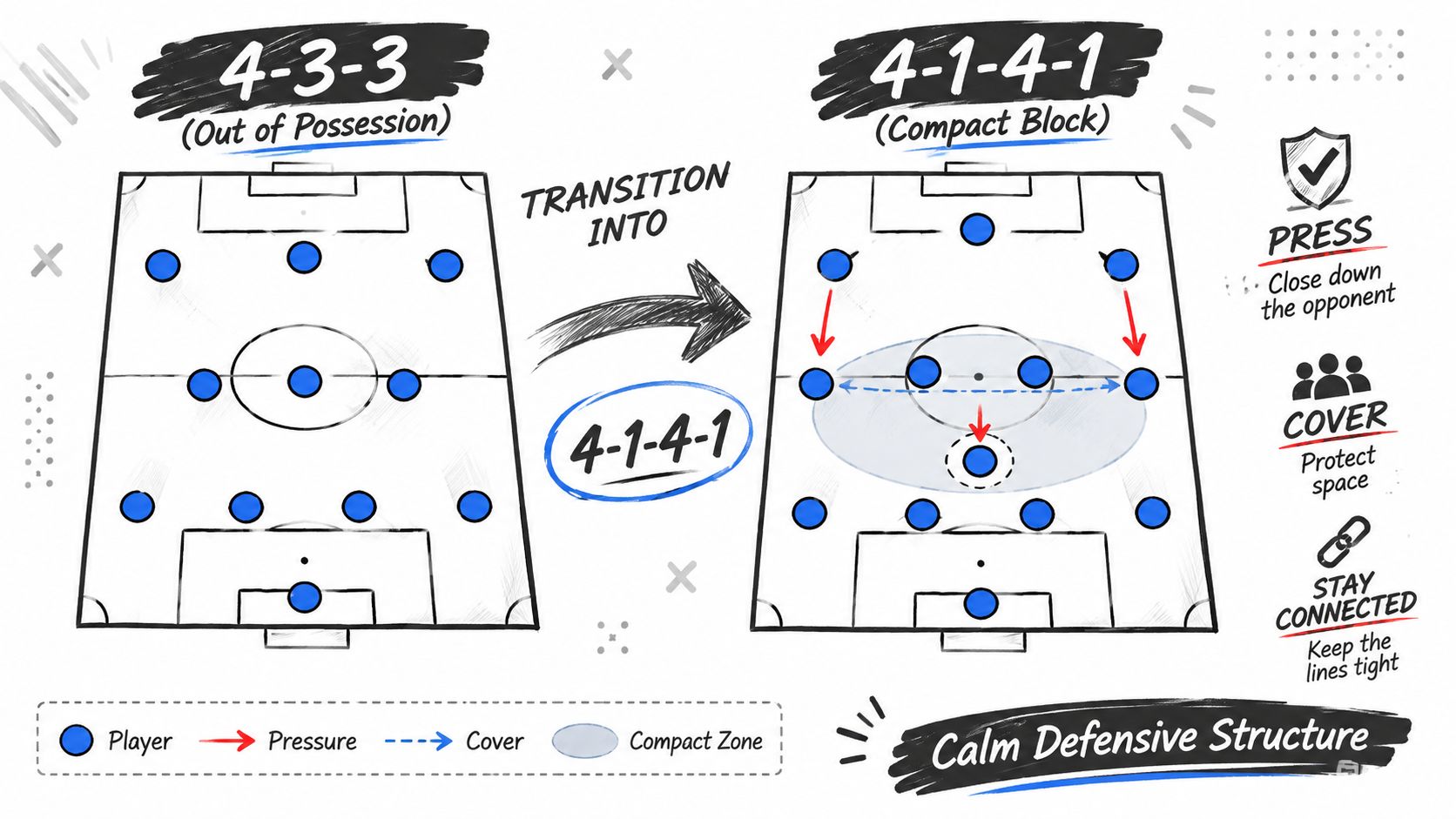
The starting 4-3-3 gives each player a position. Defensive quality comes from the decisions made after the ball moves. Out of possession, the formation commonly recovers into a 4-1-4-1: the striker and wingers form the first line, the eights screen or press in front of the pivot, and the pivot protects the space ahead of the centre-backs. The 4-1-4-1 describes where players recover so the centre stays closed.
The trigger and the sequence
Give the press a signal every player can see: a poor touch or a backwards pass to an opposition centre-back.
Nearest winger presses: closes the ball before an easy forward pass and uses the touchline as an extra defender.
Striker curves the run: blocks the pass across the back line and shows play one way.
Far winger narrows: closes the lane into midfield and stays ready for a switch.
Nearest eight jumps: moves towards the opposition pivot while the second eight remains connected to the holding midfielder.
Pivot holds the centre: stays in front of the centre-backs and covers an opponent receiving between the lines.
The midfield screen works like a sliding door: when one eight moves, the other closes the space behind him. The jump should begin as the pass travels so the receiver cannot turn before contact. If both eights leave the line together, the pivot faces runners alone. If the far winger stays high and wide, a switch exposes the full-back. The rest-defence rule is clear: the non-jumping eight stays close enough to protect the pivot, while the weak-side full-back tucks in early enough to meet the first switch.
A three-line pressing practice
Set the striker and two wingers against four defenders and a goalkeeper. Place two eights and the pivot behind them across the halfway zone. The front three send play towards one side while the screen removes the pass back through the middle. A regain in the attacking half earns a point. A central pass through the screen restarts play because the middle is the route the midfield three are set to protect.
Review three decisions whenever the defending team escapes: whether the striker's curved run removed the return pass, whether only one eight jumped, and whether the far winger and weak-side full-back moved before the switch. These checks turn a broken press into three coachable choices.
For players learning the press, use a narrower area and start with passive defenders. For an experienced group, release an opposition pivot who can turn, then allow the defending team to attack a counter-attacking target after breaking the first line. The front three still direct play wide while the midfield three must join the pressure and keep one player connected to the pivot.
What the Research Says About Results
Formation data shows what a shape tends to produce across many matches, which is different from proving it wins them. A 2024 comparison reported match totals generally ranging from 303 to 504 passes and 6.5 to 11.5 shots. The 4-3-3, 4-2-3-1 and 4-4-2 produced the most passes, shots and pressure received, with the 4-3-3 leading across those three indicators.
The scoring picture is narrower. In the 2026 machine-learning study on formation effects, the 4-3-3 produced a statistically significant goals-difference advantage of 0.17 goals when directly compared with a 5-4-1, while broader effects on scoring remained modest. Read together, the results describe attacking volume rather than a guaranteed return on the scoreboard.
Judge the shape by spacing and responsibilities, then check whether its passing volume becomes shots and what the rest defence did when possession was lost.
Frequency data needs the same care. The Premier League published 114 uses of the 4-3-3 in 2024/25, down from 172 in 2023/24. A 2024 Frontiers in Sports and Active Living study found 1,989 analysed games using the 4-3-3, second only to the 4-2-3-1. A 2025 Frontiers study comparing tactical data providers found only 30% agreement, equivalent to 13 of 44 formation identifications. Analysts should compare labels from one source and check them against match video, phase by phase rather than by formation name alone.
None of these counts answer whether the eights stayed connected to the pivot when a pass was lost. That judgement still comes from watching what each position decided after the ball moved.
Variations of the 4-3-3 and When to Use Them
Variations answer match problems. They don't improve a team because the label sounds modern, and each one moves cover somewhere else.
Variation | Change from the base shape | When it fits | Main trade-off |
|---|---|---|---|
Back three in build-up | A centre-back steps into midfield and the full-backs advance | Against a high first press | Less cover behind the advancing full-backs |
Defensive 4-5-1 | Wingers drop to form a line of five | When protecting a flank or a lead | Less threat from wide areas |
False nine | The striker drops into midfield | When the team wants a numerical advantage in the centre | Less direct threat behind the back line |
Inverted wingers | Wingers cut inside on their stronger foot | To overload the central lane | Relies on full-backs providing width |
Choosing the switch
A back three in build-up suits a high first press because the extra player near the ball creates a cleaner passing lane. The cost appears on turnover. Advanced full-backs leave wide channels that the nearest eight or centre-back must cover diagonally, not by sprinting straight back towards goal.
The defensive 4-5-1 fits when a flank needs protection or a lead needs control. Wingers recover beside the eights, distances shrink, and opponents find fewer gaps between units. Attacking transitions lose width, so the striker needs support quickly or clearances keep returning.
A false nine drops the striker towards midfield to outnumber the centre and draw a centre-back out. That movement only pays if a winger or eight runs into the vacated depth at the same moment. Without that run, the team gains a spare pass and loses its threat behind.
Inverted wingers cut inside on the stronger foot to shoot, combine or overload the central lane. Full-backs then own the touchline, which changes recovery distances for the whole side.
Formation names are shorthand. Every variation still needs two rules stated aloud: who covers the pivot, and who recovers the wide space. Coaches should describe those responsibilities whenever the label changes, because players defend spaces and opponents, not shorthand.
Common Setup Errors and How to Fix Them
A wrong starting position in the 4-3-3 rarely costs a goal on its own. The cost arrives two passes later, when the player who should have covered a space is still recovering from the wrong decision. The table below links each symptom to a likely cause and a fix that fits one session rather than a full rebuild.
Symptom | Likely cause | Fix |
|---|---|---|
Pivot isolated after a turnover | Both eights and wingers push forward together | One eight covers the pivot's side on every turnover |
Winger never receives in the final third | Winger drifts inside before the ball arrives | Hold width until the full-back's position is clear, then move inside |
Counter-attack after a full-back overlap | No rest-defence rule | Overlap only when a centre-back or the pivot is covering the space |
Midfield three look static on the board | Positions taught as fixed points | Teach diagonal recovery runs and rotations between the three |
Watch the first three seconds
After a turnover, the first three seconds show whether the rules exist. A positional fault means nobody covered the space, a timing fault means the press or recovery started late, and an instruction fault means players were never given a clear rule. Sorting the fault first stops a coach fixing the wrong thing.
Each symptom then has a quick question that narrows the cause:
Pivot isolated: on the last three turnovers, did an eight turn toward the pivot before chasing the ball?
Winger never receives: was the winger still holding the touchline when the pass should have come, or had he already drifted inside?
Overlap punished: when the full-back crossed halfway, was a centre-back or the pivot already standing in the space behind?
Static midfield: after each pass, does the passer move to a new lane, or stand and watch the ball?
A short training game turns the diagnosis into a habit. Use 6v4 on a half-pitch, with six attackers: one pivot, two eights and three front players, against four defenders. On every turnover, one eight must move toward the pivot's side before pressing, and the attacking team scores a point for a switch of play that reaches the far winger. The constraint rewards width without letting both eights leave the centre together.
A diagram only helps if player numbers, positions and arrow meaning are checked before it's shared. A run arrow mistaken for a pass teaches the wrong movement.
Start with one fix and give it a check players can see. If the pivot coverage is the chosen fix, the evidence is simple: on the next three turnovers an eight turns toward the pivot before anyone else reacts, and centre-backs stop facing runners alone in open space.
Map Your 4-3-3 Before Your Next Session
Turn the shape into one board before the next session. A starting picture of eleven dots tells players where to stand. The board earns its place when it shows what each position must decide after the ball moves, and a soccer formation builder guide explains that workflow in more detail.
Choose the starting shape: select 4-3-3 from the free formation library, which also includes 4-2-3-1, 3-2-5, 4-4-2, 3-4-3 and 5-4-1.
Map the football action: add the wide triangle, the press trigger or the turnover rule that matters most.
Add the coaching detail: label who covers the pivot's side and who replaces the width when a winger comes inside.
Export and communicate: share the finished board with players or staff.
With TFA Tactics Board (Free Tactics Board), by Tactical Football Analysis, player positioning, the ball, passing arrows, running movements, coaching notes and PNG exports are free, and no software download is required. The £9 membership adds multiple saved boards, advanced drawing and equipment, small-sided pitches, portrait mode and complete colour control, with dribbles, curves, shots, zones, spotlights and tactical lines among the member drawing tools.
Because boards are stored in the current browser, export a PNG or keep a copy of the coaching notes. Pair one build-up diagram with one pressing diagram on the free board before adding anything else.
Build the starting 4-3-3, draw the first pass and the recovery run that protects the pivot, then export a clean PNG players can read. TFA Tactics Board gives coaches, analysts and educators a free browser-based board for formations, movement arrows, labels and coaching notes, without a software download.